
































By Bruno Esposito
Although most people, when talking about rights or laws, immediately think of things that limit their freedom or of instruments of power, the truth, objectively speaking, is quite different if we consider what rights and laws mean for us as “social animals” who are “by nature” in relation to our fellow human beings.
It is our very social nature that requires the presence of legal norms, whose main task is to realize, promote and protect the dignity of the being and actions of every member of any type of society. Hence, law is not a “superstructure,” or even a “lesser evil” to limit conflicts and abuse, but rather an ontological dimension of human nature, wisely summarized by the maxim: Ubi homo ibi societas, ubi societas ibi ius. Ergo ubi homo ibi ius (Where there is a person, there is society; where there is society, there is law. Therefore, where there is a person, there is law). Thus it is the person that law and justice must always serve; every primary and original legal system, such as the State and the Church, is called upon to acknowledge that it does not create law and justice, but only laws, and that legal systems and laws are always subject to justice and law, as the German jurist Erich Kaufmann pointed out.
This profound conviction prompted a group of professors from state and ecclesiastical universities to found the Consociatio Internationalis Studio Iuris Canonici Promovendo after the Second Vatican Council, with the aim of “deepening and spreading the study of canon law and state law relating to the Catholic Church and other Churches and ecclesial communities” (Statute, art. 2), a task that the current apostolic constitution on the Roman Curia Praedicate Evangelium assigns to the Dicastery for Legislative Texts (cf. art. 175, §1). The association has tirelessly pursued this goal through international conferences, study days at various universities, the promotion of numerous initiatives and publications, celebrating its fiftieth anniversary in 2023, the proceedings of which are collected in this volume.
The centrality of the person – but also the specificity of the faithful – in the study and administration of law was reiterated by Pope Francis in his message, which opens the publication: “Without a doubt, at the center of canon law and civil law is the person; the peculiarity of canon law is the person as redeemed in Christ, as a member of the faithful in the Church. Through laws, both the Church and civil society aim to procure the common good; however, in the Church it is not only an external order , but an expression of the presence of Christ the Savior” (pp. XI-XII).
After greetings from Cardinal Péter Erdő, Bishops Filippo Iannone and Juan Ignacio Arrieta, and Prof Cesare Mirabelli, the collection is divided into two parts. The first part traces the association’s history, reviewing the published acts of the international congresses and some of the topics discussed, such as synodality, the role of the canonist in North America, associations in the Church, the presence of Eastern law, and the laity in the Church.
In the second part, Professors Nicolussi, Coughlin, Cappellini, Cattaneo and Echappé develop, at various levels and from different perspectives, the mutually beneficial relationships that arise whenever a dialogue is established between canon law and civil law in their common commitment to the good of the person and society. The concluding essay by the president, Prof. Minelli, retraces the intense relationship between the Consociatio and the post-Council pontificates, the commitment to the systematic study of the major issues raised by the Second Vatican Council and the whirlwind of epochal change underway, and highlights the educational function of canon law and its living tradition.
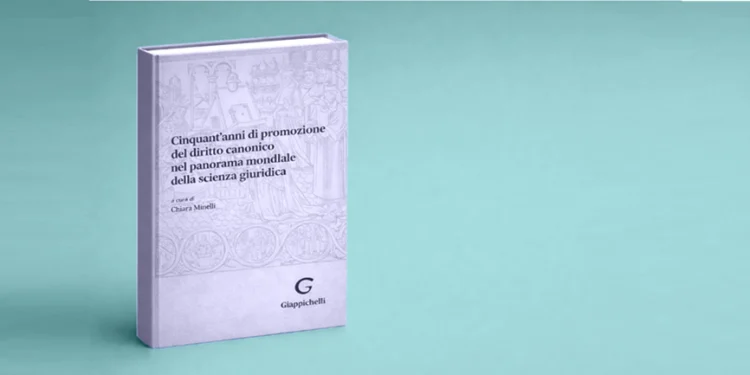
The volume “Cinquant’anni di promozione del Diritto Canonico nel Panorama mondiale della Scienza giuridica”, curated by Chiara Minelli, was published in Turin, by Giappichelli, 2025, 192, € 33,00. – La Civilta Cattolica
DOI: https://doi.org/10.32009/22072446.0126.12