













Reports by Richard Chia and Elvina Fernandez
How to live as a Christian in a pluralistic community
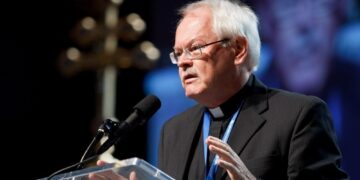
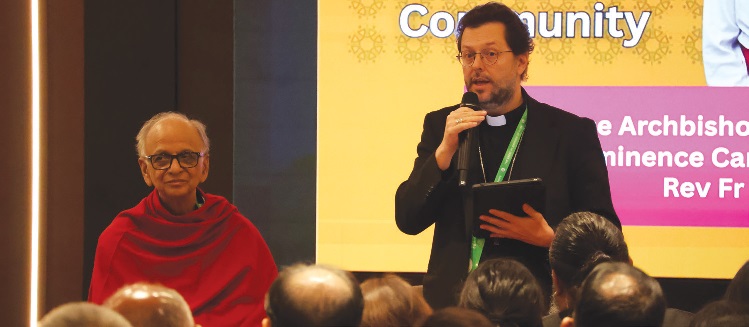
“We accept the reality that we are the minority. In many parts of Asia, we are a micro-minority. We are the salt of the earth, not the whole material.” With these words, Archbishop Emeritus Thomas Menamparampil, SDB, opened his reflection on how Christians today live alongside peoples of other religions. “We are living in a post-colonial era, where cultural and national pride are often exaggerated,” he noted.
He highlighted a common perception: “Christianity is often thought to represent the West, because many missionaries came from Western countries, and our traditions and culture have adopted their ways — in clothing, food, and more. As a result, we are often identified with the West. Yet Christianity originated from the East — from West Asia. While many of our faithful are educated or formed in the West, this can leave us feeling uprooted in our own societies.”
Archbishop Menamparampil, who is the retired prelate of the Archdiocese of Guwahati in Assam, India, encouraged self-examination and urged Christians to identify with the religious and Asian values central to our civilisations — values of reconciliation, harmony, and peace. By embracing the cultural dimension of our faith and growing close to the core concerns of society, we can touch the soul of the community. He described this approach as “whispering the Gospel to the soul of Asia,” inviting believers to cultivate intimacy with the society around them.
Cardinal Giorgio Marengo, IMC, the Apostolic Prefect of Ulaanbaatar, shared his experience of living in Mongolia since 2003, reaffirming Archbishop Menamparampil’s vision of whispering the Gospel. For him, “whispering the Gospel” means sharing the deepest part of our heart with someone we know intimately. This approach, he said, reflects the attitude of a true evangeliser, whose message at its core is the Gospel of Jesus Christ.
Cardinal Marengo spoke of his journey into the heart of Mongolia, discovering the rich and multi-layered reality of the Mongolian people — their history, culture, language, music, food, arts, politics, and economy — and how these elements shape a nation. Even after two decades, he humbly acknowledged that he is still learning.
He reflected on the invitation to enter a deeper level — to step into the beautiful, mysterious, and sacred space of another culture. To share the Gospel authentically, one must attune to the heartbeat of the people and discover the elements of grace within their culture. It is a lifelong journey, gradually uncovering the many layers that define a society, and walking gently within its sacred spaces.
Taking the Church forward in a synodal way

Fr Dr Clarence Devadass, of the Archdiocese of Kuala Lumpur, spoke candidly about synodality and its role in the life and mission of the Church. He reminded participants that this is a time for listening, sharing, and discerning together, with the guiding question: “What can I do when I get back?” Synodality, he emphasised, is about becoming agents of change in our homes, parishes, dioceses, and communities.
He clarified that synodality is not a “band-aid” solution, a project, or a management strategy — it is a spirituality, a way of being Church. “Since 2021, the word ‘synodality’ has appeared in many events and documents, often without real change. True synodality requires conversion — of mindsets, relationships, processes, and structures. It is not about adding burdens, but about infusing the spirit of synodality into what is already being done.”
Fr Clarence highlighted the three pillars of synodality: communion, participation, and mission. Communion calls the faithful to journey together without leaving anyone behind; participation invites every baptised person to share their gifts, embracing diversity; and mission reminds the Church to bring God’s love, especially to those at the peripheries. “Synodality is not an end in itself, but a pathway to transformation and renewal.”
He stressed the importance of listening to one another and to the Holy Spirit, suspending judgement, and resisting the urge for instant solutions. “Synodality is not parliamentary democracy or majority rule; sometimes the Spirit speaks through the minority voice.” Consultation must be sincere and meaningful, not token gestures.
Fr Clarence acknowledged cultural barriers in Asia, including linguistic diversity, deep respect for hierarchy, patriarchal structures, and a tendency toward silence and avoidance. These must be addressed if synodality is to flourish. Servant leadership, he noted, requires humility and accessibility.
Synodality, he reminded participants, is not limited to 2028 nor dependent solely on Pope Francis. “It is a renewal of the Church’s identity as the People of God. Through baptism, all share in the threefold ministry of priest, prophet, and king, making every member a stakeholder in the Church’s mission.”
He spoke of synodality as a force for unity, witness, and relevance, responding to contemporary challenges while remaining faithful to doctrine. Expanding the tent, he added, means not only welcoming more people, but also opening the hearts of those already inside. Synodality calls for universal participation, dialogue, and engagement — moving the faithful from passive recipients to active agents of faith.
Fr Clarence concluded by urging participants to carry the spirituality of synodality into daily life, embodying it in their communities. The session ended with a synodal gesture of prayer: the participants recited the Lord’s Prayer in their own languages, representing all the countries present.
Evangelisation in a multi-cultural and multi-religious Asia
Archbishop Felix Machado shared insights from his time at the Dicastery for Interreligious Dialogue (formerly the Pontifical Council for Interreligious Dialogue), highlighting the challenges Catholics face in evangelisation, proclamation, and sharing the Gospel across diverse cultures and faiths. He discussed a study conducted by the Dicastery on approaches to dialogue with people of other religions, which was explored in a series of sessions held around the world.
The first session in Rome invited prominent leaders from other faiths, members of the World Council of Churches, and representatives of Pentecostal and Evangelical Churches. While intended as a listening session, it became heated, reflecting the complexity of interfaith dialogue. Subsequent sessions in Toulouse, France, and Bangkok, Thailand, culminated in the creation of the document Christian Witness in a Multi-Religious World.

Produced with collaboration from the World Council of Churches and the World Evangelical Alliance, the document serves as a guide for Catholics in dialogue and mission. Archbishop Machado shared key points from the text, noting its preamble: “Mission belongs to the very being of the Church. Proclaiming the word of God and witnessing to the world is essential for every Christian.” He challenged participants with a vital question: “Is it possible to proclaim the Gospel to the vast majority of Asians, who are so diverse culturally and religiously?”
Quoting Pope Francis, Archbishop Machado emphasised that “the mission of the Church is a mission of hope.” He also referenced Pope Leo IV’s vision for evangelisation, deeply rooted in Vatican II and its predecessors, highlighting the critical role of the laity. Lay people, he stressed, are not guests in the Church but full members of the People of God, called to live their vocation in every area of society — proclaiming and witnessing the Word of God.
The archbishop outlined five key components of evangelisation, drawn from Vatican II:
• Witness
• Promotion of human dignity
• Inculturation
• Interreligious dialogue
• Proclamation of the Gospel
He further elaborated on principles for proclaiming the Gospel, citing Pope Benedict XVI’s address in Latin America: “The Church does not engage in proselytism.” Rather, the Church grows through attraction. Pope Francis echoed this, explaining that “mission is God’s work. There is no need for gimmicks or tricks. The Lord’s mandate to go forth and proclaim the Gospel comes from within, driven by love and attraction.”
Finally, Archbishop Machado offered practical guidance on how Christians can engage in evangelisation, drawing inspiration from examples in Scripture. His reflections emphasised that sharing the Gospel is a call rooted in humility, relationship, and love, rather than force or strategy. – Herald Malaysia