





By Francesca Merlo
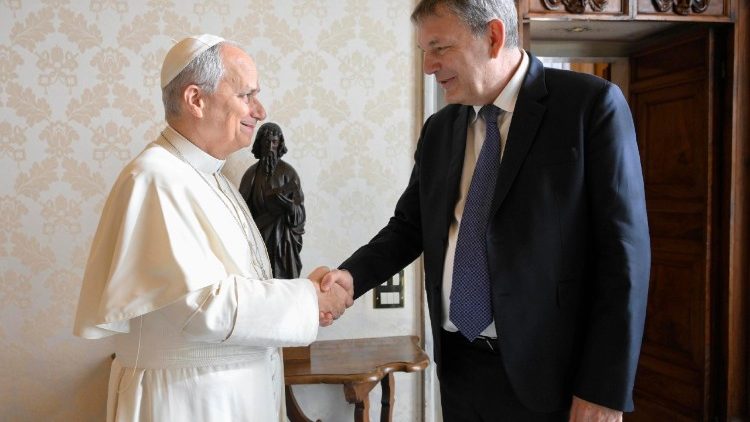
“We discussed what UNRWA does, but also what would happen if it were prevented from doing it”. Philippe Lazzarini, Commissioner-General of the United Nations Relief and Works Agency for Palestine Refugees (UNRWA), was received in Audience by Pope Leo XIV on Monday morning.
Afterward, he spoke to Vatican News about the meeting, as well as the humanitarian crisis in Palestine and the moral responsibility of a world tempted to look away.
Meeting with Pope Leo
During his audience with the Holy Father, Lazzarini explains, the conversation focused on the rapidly deteriorating situation in Gaza, the West Bank, and East Jerusalem, as well as on the wider regional consequences of a conflict that shows no sign of resolution. At the heart of the exchange, he adds, was the role of UNRWA on the ground.
“We spoke about what it would mean if the Agency were suddenly prevented from operating in Gaza or in the West Bank in the absence of a viable alternative,” Lazzarini says, explaining that such an alternative could only take the form of “capable and empowered” Palestinian institutions.
‘Temporary’ and the effect of ‘temporariness’
UNRWA was created over seventy years ago as a temporary measure, a humanitarian bridge meant to last only until a political solution was found. Its continued existence, Lazzarini says, is not evidence of institutional failure, but of political absence.
“There was a belief among Member States that they would need only a few years to solve the conflict,” he explains. “If UNRWA still exists today as a temporary yet lasting organisation, it is because, over more than seven decades, the international community has not been capable of finding a lasting political solution to the plight of the Palestinian people and to the Israel–Palestine conflict.”
Over time, the Agency’s mandate has evolved. “For the past few decades,” Lazzarini explains, “UNRWA has primarily been a human development organisation, providing what a state would normally provide to its inhabitants: education and primary health care.”
Pride in a system that works
UNRWA, he explains, has tried to provide a sense of normalcy, even where rights and opportunities are restricted. “Depending on where Palestinian refugees live, they may have been prevented from accessing livelihoods,” he notes, citing long-standing limitations in Lebanon, and the blockade imposed on Gaza.
This has increased dependency, especially as the humanitarian crisis has unfolded, Lazzarini says, and this dependency affects one’s sense of dignity. But at the same time, he adds, many Palestinian refugees are extremely proud of the education system UNRWA has delivered.
Education, Lazzarini insists, has remained untouchable. “Land has been taken away. Houses have been taken away. But education has never, ever been taken away,” he stresses. “It has always been the pride, and the hope for a better future.”
Teaching ‘normalcy’
That hope is now being tested as never before, and he admits that teaching normalcy and hope to generations growing up under bombardment, displacement, and loss is proving to be an overwhelming challenge.
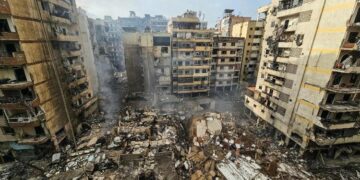
Children in Gaza have gone through nearly two years of daily, extensive destruction, Lazzarini says. “All of them have lost relatives. Many have been injured themselves. They have lost friends.” These are children, he reminds us, who were taught for decades “the importance of the universality of human rights” – only to witness those rights “blatantly disregarded when it came to them.”
“I have to say, it is extraordinarily challenging”, he says. And yet, he continues, “we cannot give up”. “Right now, we have hundreds of thousands of girls and boys living in rubble, deeply traumatised, who need to go back to a learning environment.”
Waiting for reconstruction, he warns, would be catastrophic. “We have to find ways to resume learning now,” he explains, “otherwise, we will have a lost generation”, and the consequences would extend far beyond Gaza. “If we lose this generation,” Lazzarini says, “we will be sowing the seeds for more extremism in the future.”
Funding for UNRWA
This urgency, however, sits uneasily alongside decisions by some donor states. Some express deep concern for civilian lives while at the same time suspending or conditioning funding to UNRWA. “How do you reconcile your commitment to alleviate human suffering,” Lazzarini asks, “with the fact that you refuse to channel money through an organisation like UNRWA – which has the biggest footprint in Gaza and is the main provider of education and public health?”
Humanitarian assistance, he stresses, is not limited to food. “You need shelter. You need vaccines. You need access to clean water. You need access to primary education. Many of these are provided only by UNRWA.”
“There is no doubt,” Lazzarini adds, “that there is a contradiction between saying you support a humanitarian response while refusing to support a broad range of critical activities.”
The truth behind the ‘ceasefire’
The ceasefire has reduced daily violence, but Lazzarini cautions against equating quiet with a resolution to the conflict. “The conflict is still going on every day,” he says. “There are daily breaches. Restrictions remain.” Hunger may have eased slightly, but deprivation has not. Beside food, he says, “this population needs almost everything.”
In this context, Lazzarini believes journalists have a particular responsibility. “Gaza and Palestine have been subject to a war of narratives,” he says. “There has been a lot of disinformation. The role of journalists is to keep paying attention – critically, carefully, and persistently.”
More than two years into the war, no international journalists have been allowed into Gaza. “This has to change,” Lazzarini says. “Local journalists have paid a very high price, and they need to be supported by international journalists.”
The support of the Church
Given this feeling of abandonment, the Church’s support for suffering Palestinians takes on a special meaning. “It is a message of solidarity to Palestinians, who already feel that the international community has turned its back on them,” Lazzarini says.
“It is also a message of hope,” he adds, “for minorities across the region.”
For UNRWA, that support is also practical. “We need to safeguard our operational space,” Lazzarini concludes. “We need to make sure we are considered part of the solution – an asset in building future Palestinian institutions. If we don’t do this, I don’t see where hope will be.” – Vatican News