
























By Jean D’Cunha
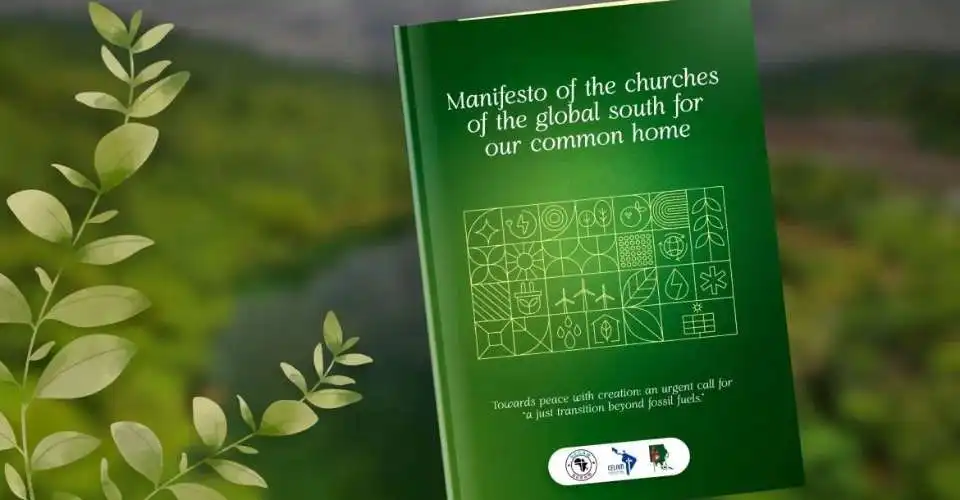
As an Asian representative, I was present at the Mar 16 launch of the landmark Manifesto for Our Common Home, signed by the heads of Bishops’ Conferences of Africa, Asia, Europe, Oceania, and Latin America and the Caribbean, and spoke on a panel about its relevance to Asia and its women.
Inspired by Laudato Si’, the manifesto demands an immediate, just transition from fossil fuels. This is a precursor to the First International Fossil Fuel Conference in Santa Marta, Colombia, that seeks to turn moral urgency into binding socio-economic and legal action.
Addressing the “Ambition Gap” of COP 30, the manifesto supports the proposed Fossil Fuel Non-Proliferation Treaty (FFNPT) to explicitly name and restrict fossil fuel production as causing the planetary crisis — a gap left by the Paris Agreement.
The manifesto advocates for halting new oil and gas exploration while managing the decline of existing production; ensuring a fair renewables transition with social protections for men and women workers and communities dependent on the industry; integrating fossil fuel phase-out targets into Nationally Determined Contributions (NDCs); wealthy nations reducing energy consumption and providing financial/technical transfers to the Global South; redirecting debt payments toward clean energy and rejecting “false” market-based solutions.
The fossil fuel industry is Asia’s economic backbone, accounting for 75 percent of global coal consumption. This accelerates global warming, alters climate patterns, and disproportionately impacts Asia’s poor.
The industry drains some US$150-200 billion annually through direct cash subsidies, unpredictable imports, and air pollution, leading to millions of deaths. Efforts to phase out fossil fuels are hindered by “locked-in” infrastructure, the need for continuous 24/7 baseload power, and the loss of millions of livelihoods.
Furthermore, Southeast Asia alone faces a US$200 billion annual financing gap to transition to renewable energy by 2030.
A critical concern is a male-dominated fossil fuel industry transitioning to a male-dominated green economy. Men comprise 84 percent of Asia’s fossil fuel workforce, mostly in formal roles, versus women’s 22 percent representation, primarily in support roles and informal jobs like coal scavenging, small-scale transport, and service provision to mine workers.
Transition for men may mean losing stable, higher-wage jobs and their “provider” identity, though they access technical RE (renewable energy) reskilling and jobs more easily.
Conversely, women make up only 20 percent of new green jobs. Because they are off formal payrolls, women are “invisibly” displaced and do not receive transition compensation when mines close. For poor or female-headed households, this income loss increases multi-dimensional poverty, vulnerability to trafficking, and increased domestic or sexual violence.
Nevertheless, RE is a game-changer. Asia leads the global transition, with record expansions in China and India.
In 2024, Asia contributed about 72 percent of new worldwide RE added capacity. When combined with affordable Long-Duration Energy Storage (LDES), it is cheaper and cleaner than traditional energy sources. RE democratizes energy through decentralized grids, creating more jobs and improving health.
Moreover, Asia has powerful grassroots movements driven by faith and human rights, advocating for the phase-out of fossil fuels. They are reshaping just transitions for formal and informal workers, including men, women, and youth. Additionally, several Asian and Pacific governments support the phase-out and the FFNPT.
The manifesto is pivotal for Asia and Asian faith-based groups because:
- It translates Integral Ecology from philosophy into action by, among others, addressing this socio-environmental crisis rooted in unsustainable development and false solutions through systemic change and ecological conversion, and ensuring climate justice among North and South, rich and poor, and for future generations.
- It closely aligns with the Santa Marta Conference, which aims to outline the financial and technical blueprint for a transition that avoids causing an economic collapse; promotes international cooperation and funding for reskilling workers including men, women, and communities dependent on the fossil fuel industry and refines financial mechanisms such as Transition Credits, Blended Finance, and Debt Conversion Monies for the energy transition and the social protection of affected communities.
- Co-crafted by Asia, it embeds the Asian experience and continues the Global South’s push for ambitious COP-30 climate action.
- It prioritizes accessible social protection and funding for the poor, indigenous groups, workers, women, and youth.
- It combines faith and ecology centered on ecological stewardship that resonates with Asian people of different faiths and belief systems, where spirituality is closely connected to the earth and the idea of interrelatedness between the creator, nature, and human beings, encouraging a unified, multi-faith response to the planetary crisis.
- It is supported by the highest levels of church leadership and can leverage existing grassroots movements and the huge Catholic constituency that supports a just transition away from fossil fuels to expand this active support base sectorally, geographically (sub-national, national, regional, and global), and across diverse faith and belief systems.
Leveraging the manifesto and existing best practices, we can drive an inclusive green transition through these key actions:
- Raise awareness about the manifesto
- Monitor fossil fuel phase-out and deployment of RE
- Engage men, women workers, and communities dependent on fossil fuels to identify their priorities, participate in transition planning and codify their priorities into National Just Transition Frameworks.
- Map green skills for men and women, using retraining and “first hire” clauses in RE jobs; offer early retirement and pensions to older workers to prevent late-career poverty.
- Invest in green economies in affected regions and offer relocation assistance when needed.
- Monitor community health concerns and deliver medical assistance.
- Formalize women’s informal roles to ensure they qualify for state compensation as “impacted workers.”
- Support women’s enrollment in STEM education, green skilling and RE leadership through affirmative action, on-site childcare, and secure transportation.
- Implement land title reforms and provide low-interest loans to women to manage decentralized solar grids; launch “green cooperatives” using solar-powered agricultural and agri-processing equipment to transition from hazardous, coal-dependent livelihoods to sustainable agriculture and a self-sufficient food economy.
- Solarize schools to ensure reliable light and cooling for better learning.
- Integrate “Green Economy” vocational training into curricula for youth, backed by scholarships – UCA News
*Dr. Jean D’Cunha is a gender expert with a continuing body of work on women’s labor migration and the links between gender, climate change, conflict and migration. She worked with UN Women in senior management and technical positions worldwide and retired as Senior Global Advisor on International Migration and Decent Work. She currently advises the Catholic Bishops Conference of India (CBCI) Office for Environment and Climate Change and the Federation of Asian Bishops’ Conference on implementing COP 30 outcomes (Global Conference of Parties 30 on Climate Change. The views expressed in this article are those of the author and do not necessarily reflect the official editorial position of UCA News.