
















By Richard Chia
Christianity arrives in Malacca
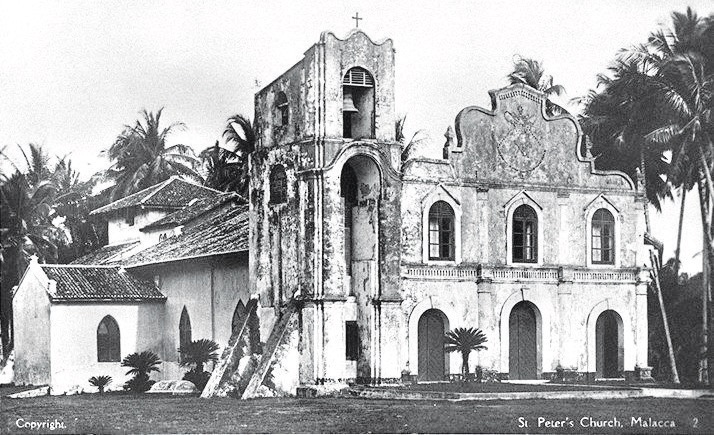
Christianity first touched Malaysian shores in 1511, arriving with the Portuguese fleet that captured Malacca. Among the sailors were eight Catholic chaplains, entrusted with the souls of Portuguese settlers and officials. Their mission soon stretched beyond their own people. As Gujarati, Chinese, and Hindu merchants arrived seeking fortune, the chaplains quietly planted seeds of faith in a bustling, multicultural port.
Dark days under the Dutch
The 17th century brought hardship. Dutch forces banned Catholic worship, destroyed churches, and forbade gatherings. The once-vibrant community shrank, and missionary work ground to a near halt. Faith survived, quietly, under the radar, waiting for a new dawn.
A new dawn in Penang
That dawn came with the British in 1786. Penang became a hub for immigrants, offering fertile ground for the Church. By 1841, the Apostolic Vicariate of Malaya was established under the French Missions Étrangères de Paris (MEP), marking a new chapter of organised mission work.
Borneo: A mission takes root
Farther east, Rajah James Brooke invited missionaries to Borneo in the 1840s to help develop the land and engage local communities. Early French efforts struggled against isolation and hardship, and were eventually abandoned. In 1880, Rome entrusted the mission to the Mill Hill Missionary Fathers. Fr Thomas Jackson, second Prefect Apostolic, arrived with Frs Aloysius Goossens, Edmund Dunn, and Daniel Kilty. Resources were scarce, but European support enabled schools and orphan care.
Arriving in Kuching in 1881, the missionaries were warmly received by Rajah Charles Brooke, who granted ten acres for mission work and directed their focus to Upper Sarawak and Rejang. With temporary lodging in a government bungalow, they quickly ventured into the interior, laying the foundations of the Church’s future.
Steady growth under Dunn
Leadership passed to Fr Edmund Dunn in 1897. A seasoned missionary, he toured stations, assessed needs, and delegated finances to focus on pastoral expansion. Borneo was divided into four quadrants — Sarawak, Baram-Labuan, Rejang, and North Borneo. Growth was steady: Rejang expanded with the Sibu mission and outreach to Chinese immigrants, while North Borneo engaged Kadazan communities, establishing strong foundations for decades to come.
From peril to perseverance
Meanwhile, in Malaya, the Diocese of Malacca, re-established in 1888 under Monsignor Edward Gasnier, MEP, grew steadily. The Church faced its ultimate trial during World War II and the Japanese occupation, when churches closed, clergy were viewed with suspicion, and schools and hospitals operated under strict control. Yet faith endured.
By 1954, the diocese had blossomed into a vibrant archdiocese with 44 local priests, 60 MEP missionaries, six Jesuits, six Redemptorists, and a Catholic population of around 105,000. From eight chaplains in Malacca to a Church spanning Malaya and Borneo, the journey had been long and challenging — but marked by unfaltering courage, hope, and lasting devotion.
Post-war renewal and the first local bishops
After the turmoil of the war, the Catholic Church in Malaya entered a new chapter in the 1950s under the leadership of Bishop Michel Olcomendy, MEP, who became the fifth bishop of Malacca in 1947. Born and ordained in France on May 29, 1926, Fr Olcomendy journeyed to Malaya that September, stepping into a parish in Kuala Lumpur serving predominantly Tamilspeaking Catholics. Determined to connect with his flock, he quickly began learning both English and Tamil, showing from the start his dedication to ministry through understanding and communication.
After a decade of service in Malaya, he was assigned to the Church of Our Lady of Lourdes in Singapore. There, his fluency in Tamil allowed him to reach Tamil-speaking Catholics in the city and across the rubber plantations of Johore. His devotion and leadership did not go unnoticed, and in 1937 he was appointed Vicar-General of the Diocese of Malacca. Following the death of Bishop Adrien Devals, MEP, in 1945, Fr Olcomendy was consecrated Bishop of Malacca in 1947 at the Cathedral of the Good Shepherd in Singapore.
Bishop Olcomendy’s vision went beyond pastoral care. He played a vital role in social development and nation-building, fostering communities of faith and service. In 1953, when the Diocese of Malacca was elevated to an archdiocese, he became Archbishop Olcomendy. He invited several religious orders to extend their mission to Singapore, including the Franciscan Missionaries of Mary (FMM), the Franciscan Missionaries of the Divine Motherhood (FMDM), the Marist Brothers, the Franciscan Friars, and the Fathers of the Sacred Heart.
He also encouraged the growth of lay movements and community organisations. Under his guidance, the Society of St Vincent de Paul (SVDP) flourished, along with guilds for Catholic teachers, nurses, and doctors. Youth movements such as the Catholic Young Men’s Association (YMCA), Young Christian Students (YCS), and Young Christian Workers (YCW), as well as the Legion of Mary, took root and strengthened the Church’s presence among families and young people.
The rapid growth of the Catholic population soon made it clear that one bishop could no longer oversee the entire diocese. In February 1955, the Archdiocese of Malacca was restructured into three sees: the Metropolitan Archdiocese of Malacca- Singapore, where Archbishop Olcomendy remained; the Suffragan See of Penang, led by Bishop Francis Chan, pic; and the Suffragan See of Kuala Lumpur, under Bishop Dominic Vendargon.
For the first time in Malaysian Church history, local bishops were appointed by Pope Pius XII. Bishop Dominic Vendargon, ordained in 1934 after training at St Francis Xavier’s Seminary in Singapore and College General in Penang, and Bishop Francis Chan, ordained in 1939 after studying at College General and serving in both Malaya and Singapore, represented a new era of local leadership.
Both bishops played key roles on the global stage, participating as Council Fathers in the Second Vatican Council (1962–1965). Their contributions laid the foundation for much of the Church’s life today: promoting active lay participation, fostering Christian unity, engaging in interfaith dialogue, and strengthening the Church’s presence in society. The appointment of these local leaders marked a turning point — a moment when the Malaysian Church truly came into its own, rooted in both faith and local identity.
Next: The Church in Peninsular Malaysia
This series is not intended as an academic or historical study, nor does it attempt to provide an exhaustive account of events, but rather offers a narrative reflection on the Church’s lived experience. All historical information in this series has been taken from various sources. – Herald Malaysia