





















By Alex Hoang
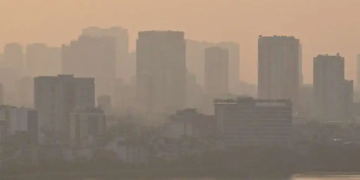
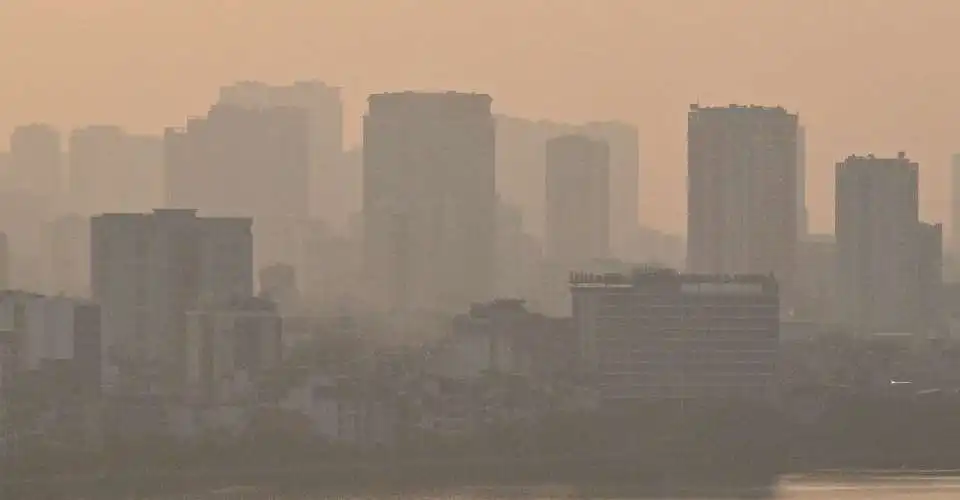
For several consecutive days, Hanoi has recorded dangerously high levels of air pollution, with air quality indices (AQI) repeatedly reaching red and purple levels.
Thick smog blankets the capital from early morning until late afternoon, reducing visibility and leaving residents struggling to breathe.
What was once seen as an occasional environmental episode is increasingly becoming a seasonal reality for Vietnam’s largest cities, particularly during the winter–spring transition.
Scientists note that temperature inversion during colder months plays a significant role in trapping fine particulate matter, particularly PM2.5, near the ground.
However, weather conditions alone do not explain the severity of Hanoi’s pollution. Inversion merely acts as a catalyst.
The primary sources remain human activities: dense traffic dominated by millions of ageing motorbikes, poorly controlled construction sites across the city, the continued burning of agricultural waste in surrounding provinces, and industrial emissions from nearby manufacturing zones.
These factors have been repeatedly identified in environmental reports over the past decade, suggesting that the persistence of pollution reflects not a lack of awareness but a gap between diagnosis and decisive action.
Professor Nguyen Thi Kim Oanh, an air pollution expert at the Asian Institute of Technology, has stressed that Hanoi’s pollution is the cumulative result of long-term urbanization and the steady expansion of emission sources.
In her view, the problem cannot be reduced to short-term weather events but must be understood as a structural consequence of rapid and uneven development.
Similarly, Hoang Duong Tung, chairman of the Vietnam Clean Air Network, has noted that traffic emissions, construction dust, and the burning of crop residue remain the primary drivers of pollution, whereas meteorological conditions merely prolong their persistence in the air.
Government’s insufficient response
Vietnamese authorities have responded with a familiar set of measures. On days with peak pollution, residents are advised to wear masks, limit outdoor activities, and keep children indoors. Schools are encouraged to reduce outdoor exercise, and health warnings are widely circulated.
While these measures may reduce immediate health risks, critics argue that they place the burden of protection on individuals rather than addressing pollution at its source.
Long-term solutions have been discussed for years, including mandatory motorcycle emission inspections, stricter controls on construction dust, bans on open burning, and expanded public transport networks.
Yet implementation remains slow and fragmented.
Motorbike emission testing, for example, has been repeatedly proposed but remains largely confined to pilot programs.
Construction sites frequently violate dust-control regulations, with penalties that are often limited.
Environmental policies often appear reactive, intensifying only when pollution reaches alarming levels rather than being enforced consistently to prevent such crises.
As policies struggle to keep pace, ordinary residents bear the consequences.
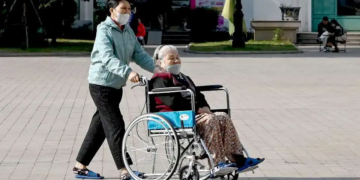
Outdoor workers — delivery drivers, street vendors and sanitation workers — have little choice but to continue working in polluted air.
“I know the air is unhealthy, but staying home means no income,” said a food vendor near Cau Giay district.
For many low-income households, protective equipment such as certified masks, air purifiers, or medical treatment represents a significant financial burden, especially as living costs continue to rise.
Health experts warn that prolonged exposure to delicate particulate matter increases the risk of respiratory and cardiovascular diseases, deepening existing inequalities in access to healthcare and economic security.
Green policy with gray realities
Against this backdrop, Hanoi has announced plans to restrict the use of fossil-fuel vehicles in inner districts by mid-2026, promoting electric vehicles (EVs) as part of its long-term strategy to reduce emissions.
On paper, the move aligns with global efforts to decarbonize urban transport. In practice, however, it has placed many residents in a difficult position.
Hanoi’s EV infrastructure remains underdeveloped. Public charging stations are limited and unevenly distributed, often concentrated in commercial complexes or newly built areas.
Meanwhile, many apartment buildings — home to a large share of the city’s population — prohibit or severely restrict EV charging in underground parking areas due to fire safety concerns.
Hoang Duong Tung has warned that transitioning to cleaner transport without adequate infrastructure risks shifting costs onto citizens.
Emission reduction policies, he argues, can only be effective when supported by reliable charging networks, clear safety regulations, and sufficient power capacity.
As environmental pressures accumulate — from floods and prolonged inundation earlier in the year to persistent air pollution in major cities — poorly coordinated “green” policies risk compounding rather than alleviating public anxiety.
Difficult year for ordinary Vietnamese
Air pollution is unfolding against the backdrop of a challenging year for many Vietnamese citizens.
This year, heavy rains, floods, and landslides disrupted livelihoods across multiple regions. Just as communities began to recover, urban residents now face another crisis—one that permeates daily life with every breath.
This succession of environmental shocks has heightened vulnerability, raising questions about the resilience of rapidly growing cities and the capacity of public policy to protect those most exposed.
Hanoi’s air pollution crisis highlights a growing disconnect between policy ambition and lived reality. The issue is no longer whether the city recognizes the problem, but whether its responses adequately reflect the conditions faced by its residents.
The question facing policymakers is not simply how to make Hanoi greener, but whether environmental transitions are being designed around the needs and constraints of the people expected to carry them out — or whether citizens are once again being asked to adapt on their own, amid uncertainty and limited support. – UCA News
*The views expressed in this article are those of the author and do not necessarily reflect the official editorial position of UCA News.