

















 First reading 1 Samuel 16:1-13
Jesse’s youngest son David is anointed king
The Lord said to Samuel, ‘How long will you go on mourning over Saul when I have rejected him as king of Israel? Fill your horn with oil and go. I am sending you to Jesse of Bethlehem, for I have chosen myself a king among his sons.’ Samuel replied, ‘How can I go? When Saul hears of it he will kill me.’ Then the Lord said, ‘Take a heifer with you and say, “I have come to sacrifice to the Lord.” Invite Jesse to the sacrifice, and then I myself will tell you what you must do; you must anoint to me the one I point out to you.’
Samuel did what the Lord ordered and went to Bethlehem. The elders of the town came trembling to meet him and asked, ‘Seer, have you come with good intentions towards us?’ ‘Yes,’ he replied ‘I have come to sacrifice to the Lord. Purify yourselves and come with me to the sacrifice.’ He purified Jesse and his sons and invited them to the sacrifice.
When they arrived, he caught sight of Eliab and thought, ‘Surely the Lord’s anointed one stands there before him’, but the Lord said to Samuel, ‘Take no notice of his appearance or his height for I have rejected him; God does not see as man sees; man looks at appearances but the Lord looks at the heart.’ Jesse then called Abinadab and presented him to Samuel, who said, ‘The Lord has not chosen this one either.’ Jesse then presented Shammah, but Samuel said, ‘The Lord has not chosen this one either.’ Jesse presented his seven sons to Samuel, but Samuel said to Jesse, ‘The Lord has not chosen these.’ He then asked Jesse, ‘Are these all the sons you have?’ He answered, ‘There is still one left, the youngest; he is out looking after the sheep.’ Then Samuel said to Jesse, ‘Send for him; we will not sit down to eat until he comes.’ Jesse had him sent for, a boy of fresh complexion, with fine eyes and pleasant bearing. The Lord said, ‘Come, anoint him, for this is the one.’ At this, Samuel took the horn of oil and anointed him where he stood with his brothers; and the spirit of the Lord seized on David and stayed with him from that day on. As for Samuel, he rose and went to Ramah.
Responsorial Psalm 88(89):20-22,27-28
I have found David, my servant.
Of old you spoke in a vision.
To your friends the prophets you said:
‘I have set the crown on a warrior,
I have exalted one chosen from the people.
‘I have found David my servant
and with my holy oil anointed him.
My hand shall always be with him
and my arm shall make him strong.
‘He will say to me: “You are my father,
my God, the rock who saves me.”
And I will make him my first-born,
the highest of the kings of the earth.’
Gospel Mark 2:23-28
The sabbath was made for man, not man for the sabbath
One sabbath day, Jesus happened to be taking a walk through the cornfields, and his disciples began to pick ears of corn as they went along. And the Pharisees said to him, ‘Look, why are they doing something on the sabbath day that is forbidden?’ And he replied, ‘Did you never read what David did in his time of need when he and his followers were hungry – how he went into the house of God when Abiathar was high priest, and ate the loaves of offering which only the priests are allowed to eat, and how he also gave some to the men with him?’
And he said to them, ‘The sabbath was made for man, not man for the sabbath; the Son of Man is master even of the sabbath.’
_____________________________________________
The Sabbath rest
“The Sabbath was made for man, not man for the Sabbath.” These words from Jesus addressed the Pharisees when they complained about His disciples picking corn on the Sabbath. The Pharisees saw the disciples’ actions as work and confronted Jesus about it. Their intention was not to uphold the true meaning of the Sabbath but to defend the man-made laws surrounding it. In response, Jesus reminded them of the original purpose of the Sabbath and why God created it.
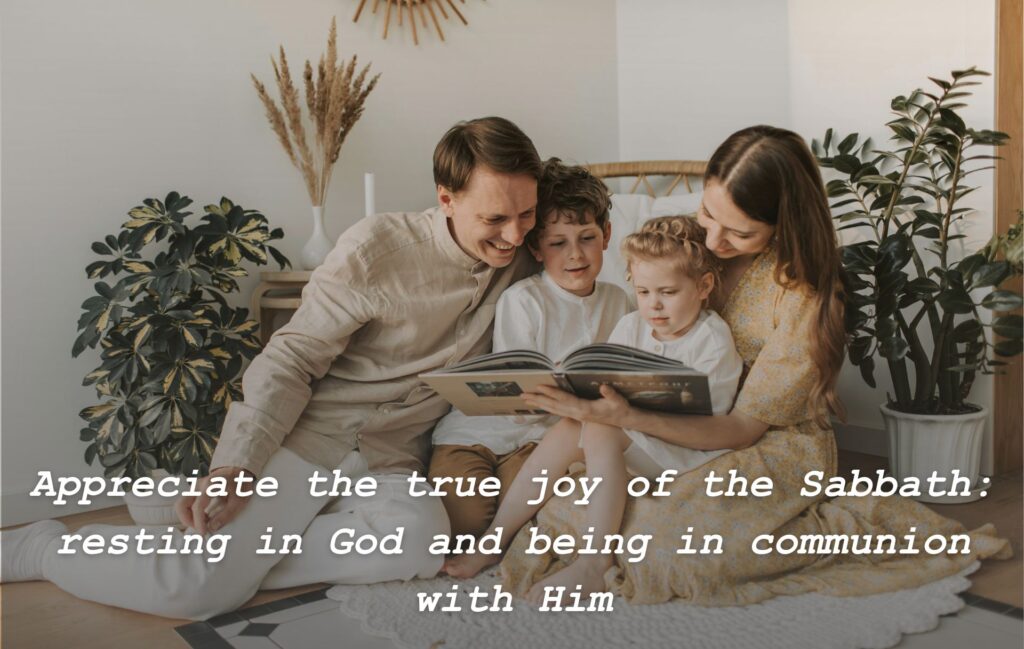
The main purpose is rest. In Genesis 2:1-3, God rested on the seventh day after creating the world. This “rest” does not mean idleness or inactivity. When God rested on that first Sabbath, it was after creating the first man and woman, whom He made out of love in His image and likeness. His rest was not solitary; rather, it was a time of communion with humanity. He took joy in being with His creation and rejoiced over each work of His hands. Today, this gospel passage challenges us to go beyond rigid religious rules and to appreciate the true joy of the Sabbath: resting in God and being in communion with Him.
Reflective question:
How can I recognise Jesus as the Lord of the Sabbath and live the Sabbath not as an obligation but as an experience of deeper communion with Him?
Acknowledgment: Reflections are based on “Prayer for Living: The Word of God for Daily Prayer Year A” by Sr Maria Jose FMVD