

















By Alex Hoang
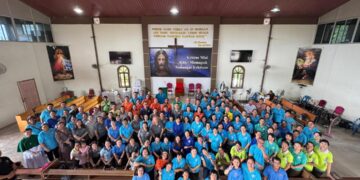
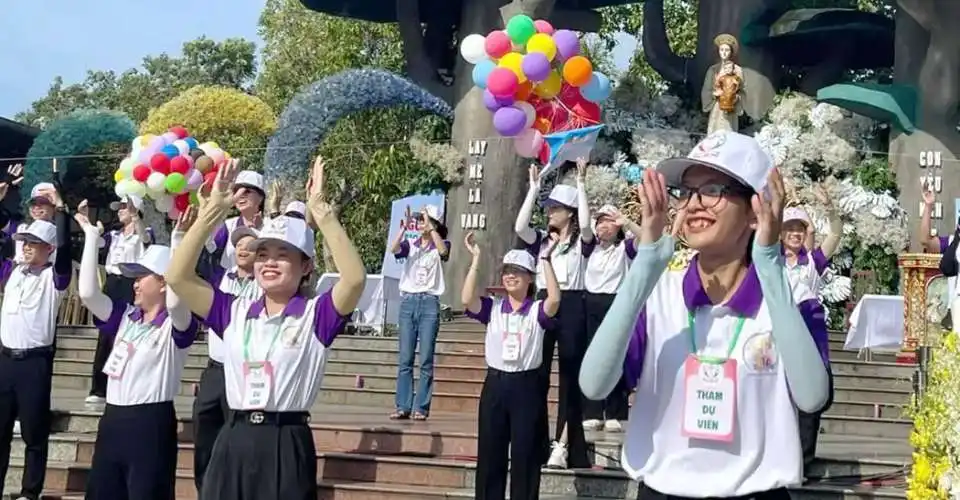
The music started like any other upbeat youth concert: lights pulsed, the bass rose, and the crowd cheered. But then came the words Kinh mung Maria… (Hail Mary…) sung over an EDM drop at the Archdiocesan Youth Day in Ho Chi Minh City on Nov 22.
It lasted barely a few minutes in an evening of cultural performances, yet within hours, clips of the moment swept across Vietnamese social media and ignited a heated national conversation.
Some young Catholics found it refreshing. But others felt a spiritual dissonance, an instinctive sense that something deeply intimate had been placed in the wrong frame. “This is a prayer we whisper, not a beat we dance to,” one woman wrote online.
A similar concern emerged months earlier when a youth band in Cho Quan Parish performed a rock-style rendition of a Vietnamese Lenten hymn during an Easter concert. Though the setting was not liturgical, many parishioners felt the shift in tone disrupted the symbolic world they associated with sacred music.
Neither incident was an act of defiance. But both revealed an underlying tension that extends beyond style or taste: What happens when the symbols of devotion meet the aesthetics of contemporary youth culture?
New cultural rhythms
Vietnam’s Gen Z Catholics live in a cultural world shaped by social media, global music trends, and fast-paced sensory experiences. Youth ministers readily admit that the traditional modes of catechesis: long lectures, slow hymns, formal gatherings no longer speak to many young people raised in an environment of instant emotion and visual stimulation.
This generational shift has motivated parishes and dioceses to reimagine youth ministry with modern staging, dynamic performances, and upbeat music. In many cases, these efforts successfully re-engage young Catholics and foster community.
Yet rapid innovation brings new risks, especially when cultural enthusiasm meets the Church’s theological and symbolic sensitivities.
A choir conductor in Hanoi, reflecting on the debates, described the issue with gentle clarity:
“In my view, the issue isn’t the musical style, it’s the choice of what they tried to ‘refresh.’ In our Catholic youth activities in Vietnam: campfires, choreography, team-building, we already use plenty of songs with pop, rock, and even rap influences. That’s completely normal. But remixing prayer texts is a completely different matter. When you take words that people usually pray quietly and put them on a DJ console or under bright stage lights, the whole meaning shifts. It’s not that the young wanted to be disrespectful, they just didn’t realize how easily the context can change the message.”
His words point to an ancient idea in Catholic thought: the principle of fittingness, the harmony between sacred content and the context in which it is expressed. Sacred language is more than text; it is a lived symbol, and its setting becomes part of its meaning.
Young Catholics themselves often hold a more nuanced view than critics assume. A university student present at the Youth Day event described experiencing both excitement and discomfort.
“I love EDM. So when the music started, it felt bold and new. But the moment I heard the prayer, something felt strange. These are words I usually whisper, kneeling, when I am alone with my Lord. Even in pop music, when someone turns a sad song into a club remix, it loses its soul. I guess prayers and hymns need the right emotional space too.”
His reflection points to a deeper truth: youth are not rejecting the sacred; they are navigating how to express faith meaningfully within the cultural vocabulary they know. Their challenge is not irreverence but discernment and discernment requires accompaniment.
Pastoral tensions
A Jesuit priest involved in youth ministry, though not connected to either event, described the pressures facing those who work with young people today.
“Youth ministry is full of trial and error. We want to keep things fresh because the young really do need freshness. But some ideas look good on paper and then feel wrong in practice.
I can understand why some parishioners reacted strongly. Maybe a few responses were too sharp, but the concern behind them is legitimate. These moments remind us that creativity needs guidance not to restrict the young, but to help them channel their gifts in ways that strengthen the community.”
His view reflects a broader pastoral dilemma: balancing youthful expression with the symbolic boundaries that protect the sacred. Freshness is necessary, but so is formation.
The intensity of the Vietnamese response also reflects the nation’s cultural background. Under the influence of Confucian tradition, Vietnamese society places strong emphasis on ritual propriety, hierarchy, and the separation of formal and informal spaces. Churches, like ancestral altars, are perceived not only as religious settings but as domains of reverence.
Thus, when sacred language is relocated unintentionally from a zone of quiet devotion into a sphere of entertainment, many retain the sense that something essential has been misplaced. The discomfort is not merely liturgical; it is cultural, symbolic, and emotional.
Globally, similar controversies have arisen from “Disco Mass” experiments in Italy to EDM versions of the “Our Father” in Mexico and K-pop-influenced hymn performances in the Philippines. But the Vietnamese reaction is shaped by deeper ritual instincts and a cultural intuition that sacred symbols must remain insulated from excessive secularization.
At the heart, these debates reveal a universal tension: in a culture of immediacy and spectacle, meaning risks being overshadowed by momentum.
Toward a mature youth ministry
Despite the controversies, the path ahead is not bleak. What emerges from these discussions is a portrait of young Vietnamese Catholics who desire both relevance and reverence. who want to express faith creatively but also seek to understand what makes certain expressions sacred.
Their enthusiasm is not the problem; it is a gift. But like all gifts, it needs formation.
With thoughtful guidance, youth events can be vibrant without losing depth. Contemporary styles can coexist with tradition. And the sacred can retain its integrity even as new forms of expression develop.
Vietnam’s Church stands at a crossroads, not a crisis. If youth and elders listen to one another, if pastoral leaders accompany rather than simply correct, the same energy that caused controversy today could become a wellspring of renewal tomorrow. – UCA News
*The views expressed in this article are those of the author and do not necessarily reflect the official editorial position of UCA News.