














 First reading Acts 8:1-8
They went from place to place, preaching the Good News
That day a bitter persecution started against the church in Jerusalem, and everyone except the apostles fled to the country districts of Judaea and Samaria.
There were some devout people, however, who buried Stephen and made great mourning for him.
Saul then worked for the total destruction of the Church; he went from house to house arresting both men and women and sending them to prison.
Those who had escaped went from place to place preaching the Good News. One of them was Philip who went to a Samaritan town and proclaimed the Christ to them. The people united in welcoming the message Philip preached, either because they had heard of the miracles he worked or because they saw them for themselves. There were, for example, unclean spirits that came shrieking out of many who were possessed, and several paralytics and cripples were cured. As a result there was great rejoicing in that town.
Responsorial Psalm 65(66):1-7
Cry out with joy to God, all the earth.
Cry out with joy to God all the earth,
O sing to the glory of his name.
O render him glorious praise.
Say to God: ‘How tremendous your deeds!
Because of the greatness of your strength
your enemies cringe before you.
Before you all the earth shall bow;
shall sing to you, sing to your name!’
Come and see the works of God,
tremendous his deeds among men.
He turned the sea into dry land,
they passed through the river dry-shod.
Let our joy then be in him;
he rules for ever by his might.
His eyes keep watch over the nations:
let rebels not rise against him.
Gospel John 6:35-40
It is my Father’s will that whoever sees the Son should have eternal life
Jesus said to the crowd:
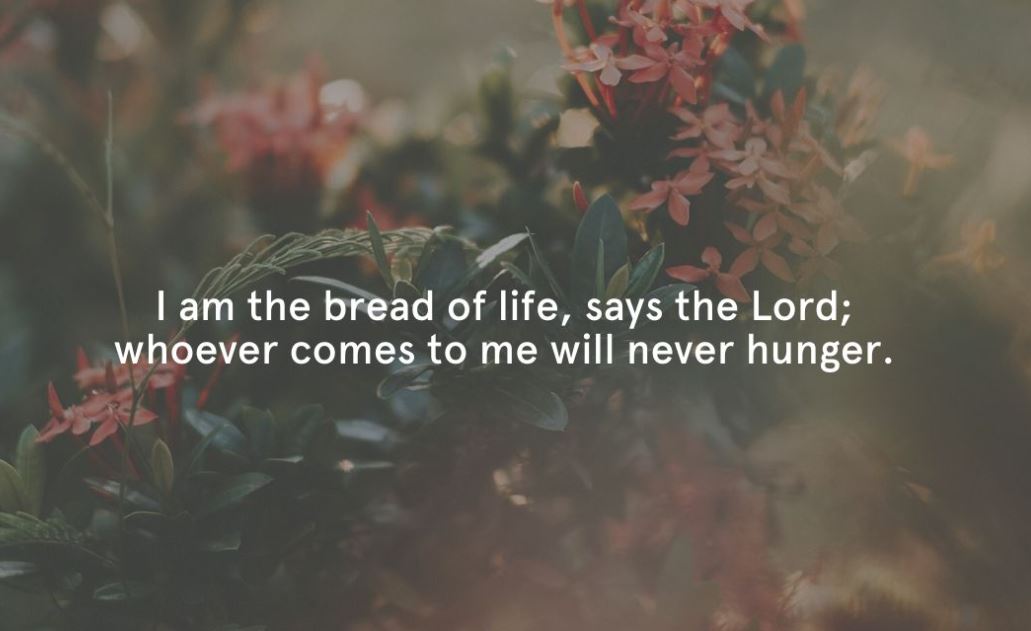
‘I am the bread of life.
He who comes to me will never be hungry;
he who believes in me will never thirst.
But, as I have told you,
you can see me and still you do not believe.
All that the Father gives me will come to me,
and whoever comes to me I shall not turn him away;
because I have come from heaven, not to do my own will,
but to do the will of the one who sent me.
Now the will of him who sent me
is that I should lose nothing of all that he has given to me,
and that I should raise it up on the last day.
Yes, it is my Father’s will
that whoever sees the Son and believes in him shall have eternal life,
and that I shall raise him up on the last day.’
__________________________________________
God is at work
In the first reading, after Stephen’s death, the early Church experienced persecution, forcing believers to leave their homes. Despite this tragedy, God remained present as they spread the Gospel. Philip travelled to Samaria, sharing Christ’s message and bringing great joy to the town. What began as suffering transformed into a mission, demonstrating that God can work through our circumstances. Even in difficult times, He is actively involved in our lives, bringing grace in unexpected places.
In the Gospel, Jesus says, “I am the bread of life… whoever comes to me I shall not turn him away.” In a world where we often feel scattered, uncertain, or lost, He promises that we are loved and not forgotten. Jesus clearly states that it is the Father’s will for Him to keep all that has been given to Him. This is a promise of unconditional care. Even when life feels overwhelming, as it did for the early Christians who were scattered, Jesus is holding us close and guiding us toward a full life and love.
Reflective question:
Today, how can I turn to Jesus, the Bread of Life, to hold and sustain me?
Acknowledgment: Reflections are based on “Prayer for Living: The Word of God for Daily Prayer Year A” by Sr Maria Jose FMVD