













By Paterno R. Esmaquel II
AT the age of six, Shekinah Fuentes knows little about the sorrows of life.
But onstage, her face contorted in grief as she delivered a performance that drove adults, including her parents, to tears.
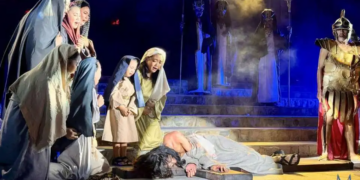
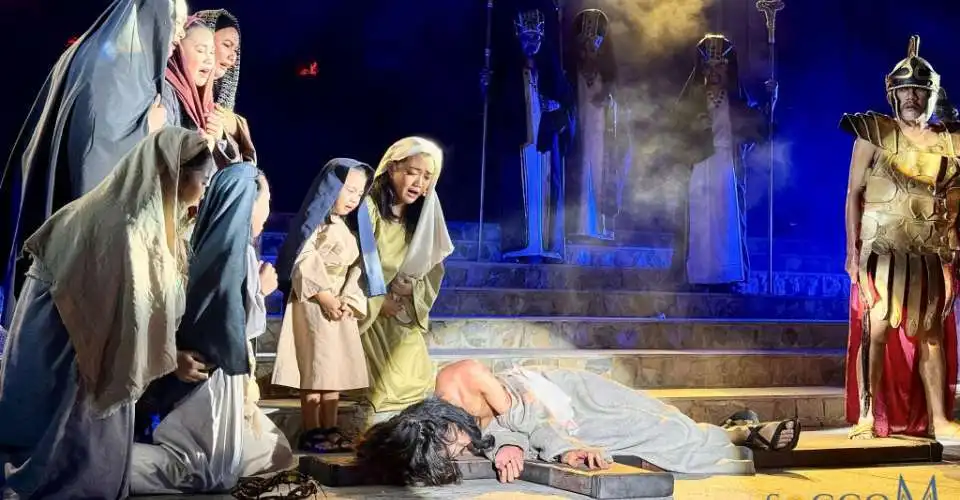
During a nearly two-hour performance on Holy Tuesday, Fuentes portrayed one of the women of Jerusalem who cried as they met Jesus on his way to Calvary.
That same evening, on another part of the stage was Leo Llorca, a 28-year-old humble water delivery boy.
He played the mighty Caiaphas, the high priest who plotted to have Jesus put to death.
Fuentes and Llorca were among around 100 young people performing the Senakulo, a traditional Filipino stage play on the Passion of Christ, at the National Shrine of Our Lady of Fatima in Valenzuela City, in the northern part of the Philippine capital region.
Historic roots, new appeal
The Senakulo tradition dates back to the 17th century, when the Philippines was under Spanish colonial rule. It is traditionally held in church buildings or on the streets, where residents gather for a one- or two-hour retelling of Christ’s Passion.
Now, aided by professional equipment and contemporary music to make it appealing to Gen Z, the Senakulo is drawing thousands of Filipino youth back to the Church at a time when church attendance has been declining.
The Senakulo has survived because it has been passed on from generation to generation.
Fuentes’ father, 35-year-old Jaycee Fuentes, has been a regular Senakulo performer since 2010.
While work-related duties prevented him from participating this year, he was happy that his six-year-old daughter could take his place.
Shekinah has loved acting since she was three years old, he says.
The preparations for the Senakulo began at home, as he and his wife, Ruan Badajos, catechized their daughter about the Way of the Cross.
“It’s become so easy for her to tap into those emotions because she sees and feels the suffering of Jesus. Before she joined the Senakulo, we really opened her eyes to the way Jesus suffered,” Jaycee Fuentes told UCA News.
Shekinah is now growing up to be a pious girl, one who leads the prayers every breakfast, lunch, and dinner.
When asked by UCA News about her prayer to God, the six-year-old quickly answered: “Lord, thank you for the gifts you have given us. Amen.”
Llorca, who was still wearing his Caiaphas costume as he was being interviewed, said he made time for the Senakulo rehearsals despite his work commitments.
He has been working in the mornings, then serving as a choir member at the parish in the afternoon.
Llorca said he has been performing in the Senakulo for five years now.
“This is my promise to God every year,” Llorca told UCA News. “It is my way of showing gratitude for the graces given by God.”
Drawing young people
Father Elmer Ignacio, parish priest of Our Lady of Fatima, said the Senakulo was a way to draw young people to the Church and develop their talents.
He said the stage play is also effective in showing the significance of Holy Week.
Parochial vicar Father Jan Brian Samson, who also served as spiritual adviser to the performers, cried as he watched the Senakulo on Holy Tuesday.
The drama breathed new life into the words of the Lord’s passion, he added.
Father Nicanor Lalog II, chaplain of the nearby Our Lady of Fatima University, noted how the Senakulo allows the youth to give “their own interpretation of the Passion of Christ.”
“This is the word becoming flesh in them. This is the homily by the children,” Lalog told UCA News.
The children’s homily took on a different form in the City of Manila, another part of the capital region, where another modern-day Senakulo took place on Holy Wednesday.
At the National Shrine and Parish of Our Lady of Loreto, the Senakulo interpreted the Passion of Christ in the light of modern-day problems such as poverty, disinformation, and the violence caused by former president Rodrigo Duterte’s war on drugs.
The performers would first show the traditional scenes in the Passion of Christ, such as the scribes and Pharisees making false accusations against him.
Then, the performers would depict how similar forms of suffering afflict ordinary people today. Thousands of drug suspects, for instance, were killed in Duterte’s war on drugs without having been able to defend themselves before a court of law.
Father Eric Adoviso, parish priest of Our Lady of Loreto, told UCA News that they chose this approach because of the intricate link between the time of Jesus and the modern day.
“The things that happened to Jesus still happen today,” Adoviso said.
‘A bright future’
When asked about the drug war references possibly stirring controversy, the priest emphasized that the Church’s teaching is simple — “Thou shalt not kill” — and the Church should always stand by this teaching.
Jesus himself, he added, was a victim of the death penalty, which the Church opposes.
In any case, Adoviso said their parish is happy about youth involvement in their Senakulo.
“We want our Church to be inclusive,” the Filipino priest said.
Bryan Agir, the script manager of this year’s Senakulo at Loreto, said he was in awe of their stage play this year.
“I see a bright future, a bright present,” Agir told UCA News. “To see young people responding to such works of the Church — especially because the reward is not too big, sometimes even immaterial — fills us with hope.” – UCA News