















By Herald Malaysia
Meeting with the Dicastery for Divine Worship and the Discipline of the Sacraments
The second day of the ad limina visit began in the stillness of dawn at the chapel of the Domus Romana Sacerdotalis, where the bishops gathered for the Eucharistic celebration before the day’s official engagements unfolded. The Mass was celebrated by Bishop Bernard Paul, with Fr Robert Leong serving as concelebrant. After breakfast, the delegation prepared for its first meeting of the day.
A short walk through the Vatican brought the group to the Dicastery for Divine Worship and the Discipline of the Sacraments. The building stands just along the pathway leading towards St Peter’s Square, where streams of pilgrims and tourists from across the globe gather daily in awe of the heart of the Catholic Church.
Amid the bustling crowd, the bishops moved quietly in their black clerical attire and Roman collars, almost blending into the rhythm of Vatican life. There was something quietly striking about the scene — shepherds from Malaysia, Singapore and Brunei walking side by side through one of the world’s most recognisable public spaces, largely unnoticed by the throngs around them.
The Dicastery for Divine Worship and the Discipline of the Sacraments plays a central role in safeguarding and promoting the sacred liturgy of the Church in accordance with the renewal called for by the Second Vatican Council. Its work includes ensuring that liturgical norms are faithfully observed throughout the universal Church, overseeing the revision and publication of liturgical texts, and granting recognition to legitimate adaptations suited to local cultures as approved by Episcopal Conferences. The Dicastery also oversees particular liturgical calendars, as well as the Propers of Masses and the Liturgy of the Hours used in various regions around the world.

Awaiting the delegation at the Dicastery was its Prefect, Cardinal Arthur Roche, who warmly welcomed the bishops and personally chaired the meeting together with the Dicastery’s Secretary, Monsignor Vittorio Francesco Viola.
Representing the Episcopal Conference on liturgical matters was Cardinal William Goh, Archbishop of Singapore and the bishop overseeing liturgy for the Conference. In his presentation, he offered the Dicastery an overview of the liturgical life of the Church across Malaysia, Singapore and Brunei — reflecting on the richness, challenges and pastoral realities shaping worship in the three nations.
The discussion unfolded in a spirit of openness and fraternity, touching on the diverse cultural expressions of worship within the region while reaffirming the Church’s commitment to preserving the sacredness and integrity of the liturgy.
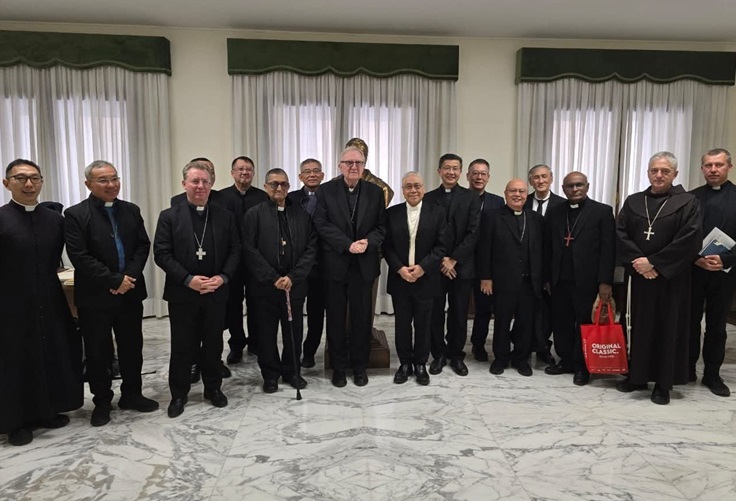
As the hour-long meeting drew to a close, Cardinal William presented Cardinal Roche with a commemorative plaque on behalf of the Episcopal Conference to mark the ad limina visit. The encounter concluded with a group photograph — a simple yet meaningful moment capturing the communion shared between the bishops of the region and the Dicastery entrusted with safeguarding the Church’s liturgical life.

Meeting with the Dicastery for the Clergy
The delegation’s second meeting for the day required only a brief 100-metre walk across the vast expanse of St Peter’s Square to another Vatican building housing the Dicastery for the Clergy. Though the distance was short, the significance of the meeting weighed heavily upon the bishops, for the Dicastery oversees matters central to the life and future of the Church’s ordained ministry.
The Dicastery for the Clergy is responsible for all matters concerning diocesan priests and deacons, while also assisting bishops in the pastoral care and formation of their clergy. Its responsibilities include overseeing seminaries, ensuring that priestly formation is carried out in accordance with Canon Law, and fostering vocations to the priesthood throughout the universal Church.

Welcoming the delegation was Cardinal Lazzaro You Heung-sik, the Korean prelate appointed Prefect in 2021 — notably the first Korean to head a department within the Roman Curia. The meeting reflected not only the universal nature of the Church, but also the growing voice and contribution of Asian Catholics within its leadership structures.
Representing the Episcopal Conference on matters concerning seminary formation was Bishop Richard Ng, who presented the regional realities faced by the Church in Malaysia, Singapore and Brunei. His discourse touched candidly on the acute shortage of priests, the advancing age of many clergy members, the declining number of priestly vocations, and the pastoral challenges posed by the steadily growing Catholic population across the region.
As Cardinal Lazzaro was not fluent in English, the discussion unfolded primarily in Italian, with simultaneous translation assisting the delegation throughout the exchange. Despite the language barrier, the atmosphere remained warm and attentive, reflecting the shared concerns and hopes of shepherds seeking to strengthen the future of the priesthood.

From the outset, the bishops had been reminded that the ad limina apostolorum visit was not merely ceremonial, but very much a working pilgrimage. The sheer scale of the Roman Curia itself underscored this reality. With 16 Dicasteries, the Secretariat of State, tribunals, pontifical commissions and various Vatican offices, it would have been impossible to visit every department within a single week.
Even so, the schedule remained demanding. Over the course of the visit, the delegation was slated to meet representatives from 12 Dicasteries, the Secretariat of State, a Tribunal, a Pontifical Commission and the Secretariat of the Synod — a packed itinerary requiring careful coordination, long hours and constant movement between meetings.
Following a brief lunch break, the bishops once again made their way through the Vatican corridors and courtyards towards their third appointment of the day — already their seventh formal meeting since the start of the ad limina pilgrimage.

Meeting with the Dicastery for Laity, Family and Life
Although the offices of the Dicastery for Laity, Family and Life were located only some 2.6 kilometres from the domus, the journey through Rome’s famously narrow streets and relentless traffic stretched into nearly half an hour. It was yet another reminder that in Rome, distances are often measured not merely in kilometres, but in patience.
Upon arrival, the bishops’ delegation was warmly received by Dr Gleison De Paula Souza, who represented the Prefect, Cardinal Kevin Joseph Farrell, who was away at the time. Joining him were the Dicastery’s Under-Secretaries, Dr Linda Ghisoni and Dr Gabriella Gambino, who participated actively in the exchange with the bishops.
The Dicastery for Laity, Family and Life carries one of the broadest pastoral mandates within the Roman Curia. Its work touches nearly every stage of human life — from childhood to old age — encompassing the pastoral care of families, youth, lay faithful, and the promotion and protection of human life itself. At its heart lies the mission of encouraging lay Catholics to recognise and live out their vocation both within the Church and in society.

Chaired by Dr Gleison and his team, the meeting quickly moved into a thoughtful discussion on the realities faced by families and young people in Malaysia, Singapore and Brunei.
Speaking on behalf of the Episcopal Conference was Archbishop John Wong, who oversees the Episcopal Regional Commission for Family, Laity and Life. In his presentation, he affirmed that despite the many social changes taking place, the family continues to remain the bedrock of the Church within the region.
At the same time, he acknowledged the growing challenges confronting family life today. Archbishop John reflected on how rapid socio-economic development, urbanisation, demanding work schedules, competitive lifestyles and the influence of digital and global culture have gradually shifted society away from traditional extended family systems towards smaller nuclear households. These realities, he noted, have significantly reshaped family relationships, faith practices and community life.

Responding to the presentation, Dr Gleison remarked that such challenges were by no means unique to Malaysia, Singapore and Brunei, but reflected a broader global phenomenon affecting families worldwide. Nevertheless, he commended the bishops for the many pastoral initiatives undertaken in reaching out to young people and families across the region.
Particularly encouraging for the Dicastery was the sharing by Archbishop Simon Poh, who oversees youth and campus ministry for the Episcopal Conference. He spoke of an increasing desire among young people for moments of silence, contemplation and deeper spiritual meaning within their faith journey and liturgical life — a reflection that resonated strongly with the Dicastery officials.
Amid conversations about digital culture, modern pressures and changing family structures, the longing of young people for stillness and spiritual depth emerged as a quiet but hopeful sign for the future of the Church.

Meeting with the Dicastery for Promoting Integral Human Development
The final meeting of the day — and the eighth formal engagement since the start of the ad limina visit — brought the bishops’ delegation to the Dicastery for Promoting Integral Human Development. Though the long day had already stretched across numerous Vatican offices and discussions, the atmosphere remained attentive and engaged, particularly because this was a Dicastery with which the Episcopal Conference of Malaysia, Singapore and Brunei already shared a meaningful connection.
That relationship had been strengthened earlier in January 2025 through the visit of Alwin Macalalad to the Episcopal Conference. His visit not only fostered closer collaboration, but also opened clearer channels of communication between the local Church and the Vatican office entrusted with some of the world’s most pressing humanitarian and social concerns.
The Dicastery for Promoting Integral Human Development carries one of the broadest and most socially engaged mandates within the Roman Curia. Its mission centres on promoting the dignity of every human person created by God, while addressing issues relating to human rights, justice, peace, healthcare, migration, labour, economic systems and humanitarian crises. It also plays a key role in advocating care for creation and safeguarding the earth as humanity’s “common home” — themes that have become increasingly urgent in the life of the universal Church.
Welcoming the delegation was Cardinal Michael Czerny, together with Secretary Sr Alessandra Smerilli and Under-Secretaries Fr. Fabio Baggio and Monsignor Jozef Barlaš.

In his opening remarks, Cardinal Czerny welcomed the bishops warmly before presenting a short video introducing the Dicastery’s mission and some of its work across various parts of the world. The presentation offered a glimpse into the Church’s global response to poverty, displacement, ecological concerns and humanitarian suffering — realities that transcend borders and cultures.

Speaking on behalf of the Episcopal Conference was Bishop Bernard Paul, who oversees Integral Human Development, Caritas Malaysia, and the regional commission for Migrants and Itinerants. In his discourse, Bishop Bernard outlined the many initiatives undertaken by Caritas Malaysia in serving vulnerable communities, migrants and those affected by hardship, while also candidly sharing the pastoral and logistical challenges faced on the ground.
The exchange reflected a common concern shared by both the local and universal Church — that the Gospel must continue to be lived not only in words and worship, but also through concrete acts of justice, compassion and human solidarity.

As evening settled over Rome and the final meeting of the day concluded, the bishops finally laid aside their packed schedules and formal discussions for a few precious hours of rest. After a long day that had taken them through multiple Dicasteries, countless conversations, presentations and exchanges, the delegation made its way to a Chinese restaurant for a well-deserved dinner.

The atmosphere was noticeably lighter. The intensity of meetings and official engagements gradually gave way to laughter, casual conversations and shared reflections over warm dishes and familiar flavours from closer to home. Amid the clatter of plates and the hum of evening diners, the bishops found a rare moment to simply unwind — no speeches, no presentations, no schedules to race against.

For a brief time, the demanding pace of the ad limina visit paused around a dinner table in Rome, where fraternity, friendship and simple fellowship quietly nourished weary shepherds at the end of a very full day.