






• About
  • Contact
Saturday, May 23, 2026
Catholic Sabah
  • News
    • All
    • Asia
    • Focus
    • Local
    • Nation
    • Vatican
    • World
    Analysing AI’s impact on media, communities and inequalities

    Analysing AI’s impact on media, communities and inequalities

    Synod releases document on path toward 2028 Ecclesial Assembly

    Synod releases document on path toward 2028 Ecclesial Assembly

    What indigenous communities teach us about climate change

    What indigenous communities teach us about climate change

    CBCMSB’S Ad Limina Apostolorum visit to Rome 2026

    CBCMSB’S Ad Limina Apostolorum visit to Rome 2026

    Pope Leo prays for peace in Lebanon and Middle East

    Pope Leo prays for peace in Lebanon and Middle East

    CBCMSB’s Ad Limina Apostolorum to Rome 2026

    CBCMSB’s Ad Limina Apostolorum to Rome 2026

    Pope Leo XIV visits the Vatican Observatory

    Pope Leo XIV visits the Vatican Observatory

    Indonesian Catholics push ‘Green Parish’ movement inspired by Laudato Si’

    Indonesian Catholics push ‘Green Parish’ movement inspired by Laudato Si’

    US Bishops to consecrate America to Sacred Heart of Jesus for 250th anniversary

    US Bishops to consecrate America to Sacred Heart of Jesus for 250th anniversary

  • Opinion
    • All
    • Im on my Way
    • Kanou Monuhid Lahan Koposizon
    • Making A Difference
    • Mantad Di Katekis Peter
    • Reflection: Straight Talking
    My Journey with the Malaysian Jesuits (Part 1)

    My Journey with the Malaysian Jesuits (Part 1)

    Faith between lectures: My journey with the CSSUKM in the late 1980s (Part 2)

    Faith between lectures: My journey with the CSSUKM in the late 1980s (Part 2)

    Faith between lectures: My journey with the CSSUKM in the late 1980s (Part 1)

    Faith between lectures: My journey with the CSSUKM in the late 1980s (Part 1)

    Inside Borneo’s longhouses: Where synodality is lived

    Inside Borneo’s longhouses: Where synodality is lived

    From France to Borneo: The Montfortian Mission to Sabah (Part 2)

    From France to Borneo: The Montfortian Mission to Sabah (Part 2)

    The 7 deadly sins offer a warning to religious influencers and their followers

    The 7 deadly sins offer a warning to religious influencers and their followers

    Why Pope Leo came to Cameroon

    Why Pope Leo came to Cameroon

    If we could only learn

    If we could only learn

  • Feature
    ‘Undivided Heart‘: Carmen Hernández on mission and virginity

    ‘Undivided Heart‘: Carmen Hernández on mission and virginity

    A Gentle Shepherd of Sibu Returns Home

    A Gentle Shepherd of Sibu Returns Home

    Alone at the table

    Alone at the table

    Centuries-old Holy Week tradition brings Filipino youth back to Church

    Centuries-old Holy Week tradition brings Filipino youth back to Church

    Quest for English leads Vietnamese woman to baptism in Malaysia

    Quest for English leads Vietnamese woman to baptism in Malaysia

    Indonesia’s children brace to face life without social media

    Indonesia’s children brace to face life without social media

    Church manifesto on a just fossil-free transition: Relevance to Asia and its women

    Church manifesto on a just fossil-free transition: Relevance to Asia and its women

    An interview with Petronella Munting: A life transformed by the Franciscan way

    An interview with Petronella Munting: A life transformed by the Franciscan way

  • Statements
    Appointment of members to the College of  Consultors

    Appointment of members to the College of Consultors

    Masses for Christmas Vigil and Christmas Day 2023

    Notice on the Matters Concerning Julia Youn of Naju, Korea

    Masses for Christmas Vigil and Christmas Day 2023

    Pastoral Statement for dispensation from fasting and abstinence on Ash Wednesday 2026

    Home 1

    Catholic Sabah Wall Calendar 2026

    The Lord has first loved us, come let us adore Him!

    The Lord has first loved us, come let us adore Him!

    Chancery Notice

    Chancery Notice

    Reshuffle of Priests

    Reshuffle of Priests

    Media Statement

    Media Statement

  • Chinese
  • Bahasa Melayu
  • Kadazan Dusun
  • JUBILEE 2025
  • About
  • Donate
No Result
View All Result
  • News
    • All
    • Asia
    • Focus
    • Local
    • Nation
    • Vatican
    • World
    Analysing AI’s impact on media, communities and inequalities

    Analysing AI’s impact on media, communities and inequalities

    Synod releases document on path toward 2028 Ecclesial Assembly

    Synod releases document on path toward 2028 Ecclesial Assembly

    What indigenous communities teach us about climate change

    What indigenous communities teach us about climate change

    CBCMSB’S Ad Limina Apostolorum visit to Rome 2026

    CBCMSB’S Ad Limina Apostolorum visit to Rome 2026

    Pope Leo prays for peace in Lebanon and Middle East

    Pope Leo prays for peace in Lebanon and Middle East

    CBCMSB’s Ad Limina Apostolorum to Rome 2026

    CBCMSB’s Ad Limina Apostolorum to Rome 2026

    Pope Leo XIV visits the Vatican Observatory

    Pope Leo XIV visits the Vatican Observatory

    Indonesian Catholics push ‘Green Parish’ movement inspired by Laudato Si’

    Indonesian Catholics push ‘Green Parish’ movement inspired by Laudato Si’

    US Bishops to consecrate America to Sacred Heart of Jesus for 250th anniversary

    US Bishops to consecrate America to Sacred Heart of Jesus for 250th anniversary

  • Opinion
    • All
    • Im on my Way
    • Kanou Monuhid Lahan Koposizon
    • Making A Difference
    • Mantad Di Katekis Peter
    • Reflection: Straight Talking
    My Journey with the Malaysian Jesuits (Part 1)

    My Journey with the Malaysian Jesuits (Part 1)

    Faith between lectures: My journey with the CSSUKM in the late 1980s (Part 2)

    Faith between lectures: My journey with the CSSUKM in the late 1980s (Part 2)

    Faith between lectures: My journey with the CSSUKM in the late 1980s (Part 1)

    Faith between lectures: My journey with the CSSUKM in the late 1980s (Part 1)

    Inside Borneo’s longhouses: Where synodality is lived

    Inside Borneo’s longhouses: Where synodality is lived

    From France to Borneo: The Montfortian Mission to Sabah (Part 2)

    From France to Borneo: The Montfortian Mission to Sabah (Part 2)

    The 7 deadly sins offer a warning to religious influencers and their followers

    The 7 deadly sins offer a warning to religious influencers and their followers

    Why Pope Leo came to Cameroon

    Why Pope Leo came to Cameroon

    If we could only learn

    If we could only learn

  • Feature
    ‘Undivided Heart‘: Carmen Hernández on mission and virginity

    ‘Undivided Heart‘: Carmen Hernández on mission and virginity

    A Gentle Shepherd of Sibu Returns Home

    A Gentle Shepherd of Sibu Returns Home

    Alone at the table

    Alone at the table

    Centuries-old Holy Week tradition brings Filipino youth back to Church

    Centuries-old Holy Week tradition brings Filipino youth back to Church

    Quest for English leads Vietnamese woman to baptism in Malaysia

    Quest for English leads Vietnamese woman to baptism in Malaysia

    Indonesia’s children brace to face life without social media

    Indonesia’s children brace to face life without social media

    Church manifesto on a just fossil-free transition: Relevance to Asia and its women

    Church manifesto on a just fossil-free transition: Relevance to Asia and its women

    An interview with Petronella Munting: A life transformed by the Franciscan way

    An interview with Petronella Munting: A life transformed by the Franciscan way

  • Statements
    Appointment of members to the College of  Consultors

    Appointment of members to the College of Consultors

    Masses for Christmas Vigil and Christmas Day 2023

    Notice on the Matters Concerning Julia Youn of Naju, Korea

    Masses for Christmas Vigil and Christmas Day 2023

    Pastoral Statement for dispensation from fasting and abstinence on Ash Wednesday 2026

    Home 1

    Catholic Sabah Wall Calendar 2026

    The Lord has first loved us, come let us adore Him!

    The Lord has first loved us, come let us adore Him!

    Chancery Notice

    Chancery Notice

    Reshuffle of Priests

    Reshuffle of Priests

    Media Statement

    Media Statement

  • Chinese
  • Bahasa Melayu
  • Kadazan Dusun
  • JUBILEE 2025
  • About
  • Donate
No Result
View All Result
Catholic Sabah
No Result
View All Result
Home News

What indigenous communities teach us about climate change

From the Arctic to Tierra del Fuego, historian Bernardo Groschopp reflects on how climate change, shifting wildlife and political borders are reshaping Indigenous communities – and why their environmental knowledge matters.

May 22, 2026
in News, World
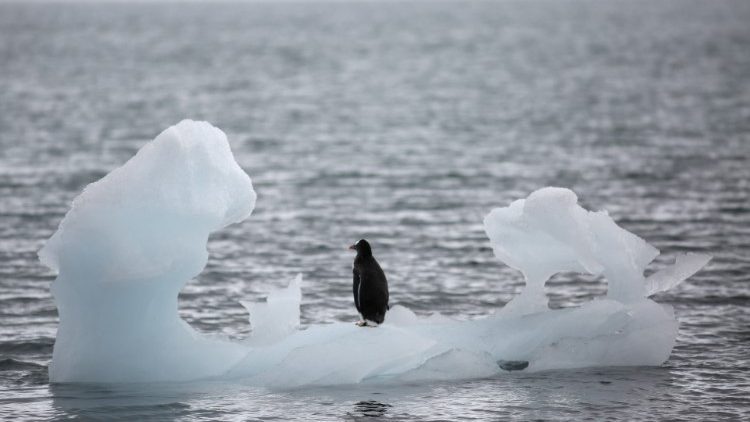
A penguin in Antarctica (Photo: Supplied)

By Federico Citterich

“They really have a perfect relationship with the environment,” says Bernardo Groschopp as he sits down in front of me. Around us, the Drake Passage is growing increasingly rough – the so-called “Drake Shake”. The waves reach a height of almost seven metres, and we can barely stay seated without falling.

I had the pleasure of meeting Groschopp, the historian aboard HX Expeditions’ MS Fridtjof Nansen, during my latest press trip to Antarctica with the company. On our way back to Ushuaia, Argentina, he delivered a lecture on indigenous populations and kindly agreed to chat with me right afterwards.

“I’ve had interactions with populations from both the Arctic and Tierra del Fuego,” says Groschopp. His remark highlights one of the key differences between the Earth’s two polar regions: the Arctic is home to indigenous peoples, while Antarctica – a frozen continent isolated from the rest of the world – has none. To encounter the southernmost indigenous communities, one must travel to the far south of South America, in Patagonia and Tierra del Fuego.

A long-lasting relationship with the environment

“But regardless of their origin, they really do care about the environment in the same way,” Groschopp adds. As he goes on to explain why, he says something I will hardly ever forget.

“Some time ago, a colleague of mine went fishing with the Sámi, an indigenous community of the Arctic Scandinavia,” he recalls. “At one point they stopped fishing and when my colleague asked why, they replied – almost confused – that they had already caught what they needed, so there was no need to fish anymore.”

Listening to him, I couldn’t help thinking about how differently we tend to treat the environment. Where those fishermen stopped once they had what they needed, we often keep going – catching more fish, extracting more resources, pushing natural systems far beyond what they can sustain. And in doing so, in addition, we frequently end up with more than we actually need, much of which eventually ends up as waste.

“On the contrary, these indigenous populations use everything they can from what they catch or gather,” Groschopp notes. “Meat, skin, bones – everything is utilized and nothing is wasted.”

As he explains this, I notice that one of the slides from his presentation is still on the screen, showing a group of Arctic indigenous people hunting a seal. That’s when a new question comes to my mind: how is climate change–driven migration of animals affecting these communities?

The impact of a changing climate

“In the past – Groschopp says – the Inuit, an indigenous community of North America, travelled all the way to Greenland following the marine animals they depended on as a warmer climatic period affected their migration patterns.” Indeed, many animal species respond to warming climates by migrating toward higher latitudes in search of suitable environmental conditions.

“Now, however, most Inuit are no longer nomadic,” Groschopp explains. “This means that when animals migrate they have to adapt and shift to hunting different species.”

But that is not always possible. Some animals require different boats, weapons, or travel distances, which can make the hunt too costly or dangerous; in some regions – moreover – there may simply not be many substitute species that provide similar amounts of food or materials.

But climate change poses other challenges for these communities as well. “Just think about thawing permafrost in the Arctic,” Groschopp adds. “Many indigenous populations live on land that was once permanently frozen, but as permafrost thaws the ground can collapse, damaging houses, roads, and water systems.”

Just as I thought he was done and I was about to ask another question, Groschopp continued, listing a whole range of other problems that thawing permafrost creates for Arctic communities.

“Combined with reduced sea ice – he explains – permafrost thaw can make Arctic coasts more vulnerable to erosion from waves and storms, forcing communities to relocate. Or again, it can alter the course of streams and rivers, making traditional hunting routes unreliable.”

But that’s not all. Thawing ground also alters vegetation and wetlands, affecting animal behaviour and movement patterns. “And that brings us back to the issue of species migration,” Groschopp notes.

“I think it’s striking how many problems thawing permafrost can create for these communities,” he then adds. “And we should not forget that this process also releases enormous amounts of greenhouse gases such as methane and carbon dioxide, creating a feedback loop that further alters Arctic environments.”

Those invisible margins

Climate change is not the only force reshaping the lives of indigenous communities. Across both the Arctic and the southern tip of South America, political borders – drawn decades or even centuries ago – continue to affect how these people can move across lands their ancestors once travelled freely.

“Geopolitics has a major impact on the lives of these communities,” Groschopp explains. “Of course, what is happening today affects them deeply, but decisions made in the past – such as the drawing of borders – also continue to shape their lives.”

“Years ago – Groschopp continues – these people could move from one place to another without restriction, whereas today they need a visa to cross national borders.”

A shared knowledge

Borders may divide the Arctic and the southern tip of South America into nations, but the environmental changes unfolding across these regions ignore such boundaries. And in many cases, the first people to notice these changes are the communities that have lived in these landscapes for generations.

Today, scientists are increasingly working with them to better understand these transformations. Hunters, fishers and local residents often notice shifts in sea ice, wildlife movements or seasonal patterns long before they appear in scientific datasets. By combining this knowledge with modern scientific tools such as satellite data and climate models, researchers are gaining a more complete picture of how rapidly these environments are evolving.

But that’s not all. “These communities not only collaborate with scientists and researchers, but they also share their knowledge with explorers,” Groschopp points out. “At the beginning of the twentieth century, for example, Nansen and Amundsen spent time living with Inuit communities, learning from them how to survive and travel in polar regions.”

Fridtjof Nansen and Roald Amundsen are among the most famous polar explorers in history. Both Norwegian, they played a central role in the exploration of the Arctic and Antarctica at the turn of the twentieth century. Nansen led groundbreaking expeditions across Greenland and the Arctic Ocean, while Amundsen became the first person to reach the South Pole in 1911.

“But indigenous communities had been sharing their knowledge with explorers long before that,” Groschopp says.

One well-known example comes from the ill-fated Franklin Expedition. In 1845, British explorer Sir John Franklin set out with two ships, HMS Erebus and HMS Terror, in search of the Northwest Passage through the Canadian Arctic. The expedition disappeared with all 129 men on board, and for more than 160 years, the wrecks remained missing.

“However, the Inuit knew where the accident had happened,” Groschopp notes. “For more than a century, we simply didn’t listen to them.”

Soon after the expedition vanished, in fact, Inuit living in the region began sharing what they had seen with British search parties. They spoke of encounters with exhausted European sailors travelling south across the ice, and of ships trapped and later abandoned in the frozen waters. They also reported finding objects that clearly belonged to the expedition, as well as camps and bodies left behind along the route. “It’s only thanks to them that we finally found the wrecks,” Groschopp adds.

“I think it’s very ironic,” he continues. “These people know so much about regions that we know so little about, and they care deeply about them. Yet we often fail to listen to them, and in doing so we also endanger them.”

This failure is not new. Many of these communities were displaced or persecuted by early Europeans in their own homelands, in some cases to the point of near extinction. As a result, entire systems of knowledge and cultural traditions have been irretrievably lost – sometimes simply because there were no surviving generations to pass them on, and often because those who encountered them did not consider their preservation important.

“If anything, we should be learning from them far more and showing them the respect they deserve,” Groschopp adds.

As he spoke, his voice almost broke with emotion, his Argentine accent suddenly more pronounced. A reminder that he comes from the same lands where many of the communities he speaks about still live – and that he understands them perhaps more deeply than many of us ever will. – Vatican News
Previous Post

CBCMSB’S Ad Limina Apostolorum visit to Rome 2026

Next Post

Synod releases document on path toward 2028 Ecclesial Assembly

Related Posts

May 23 2026
Readings

May 23 2026

May 23, 2026
Analysing AI’s impact on media, communities and inequalities
News

Analysing AI’s impact on media, communities and inequalities

May 22, 2026
Synod releases document on path toward 2028 Ecclesial Assembly
News

Synod releases document on path toward 2028 Ecclesial Assembly

May 22, 2026
Next Post
Synod releases document on path toward 2028 Ecclesial Assembly

Synod releases document on path toward 2028 Ecclesial Assembly

Recent News

Analysing AI’s impact on media, communities and inequalities

Analysing AI’s impact on media, communities and inequalities

May 22, 2026
Synod releases document on path toward 2028 Ecclesial Assembly

Synod releases document on path toward 2028 Ecclesial Assembly

May 22, 2026

What indigenous communities teach us about climate change

May 22, 2026
CBCMSB’S Ad Limina Apostolorum visit to Rome 2026

CBCMSB’S Ad Limina Apostolorum visit to Rome 2026

May 22, 2026
  • Trending
  • Comments
  • Latest
Minor reshuffle and new appointment of priests

Minor reshuffle and new appointment of priests

July 15, 2024
Enggan punya anak, antara sebab perpisahan suami-isteri

Enggan punya anak, antara sebab perpisahan suami-isteri

May 20, 2025
Expulsion of priests: A loss that turns into strength

Expulsion of priests: A loss that turns into strength

December 15, 2025
Minor transfer of priests

Minor transfer of priests

November 11, 2023
The Church wants to be more the ‘inn’ of the Good Samaritan for the sick

The Church wants to be more the ‘inn’ of the Good Samaritan for the sick

Parishioners are invited to help form prophetic and servant priests

Parishioners are invited to help form prophetic and servant priests

Archdiocesan Notice on SSPX

Archdiocesan Notice on SSPX

April 28 2020

April 28 2020

May 23 2026

May 23 2026

May 23, 2026
Analysing AI’s impact on media, communities and inequalities

Analysing AI’s impact on media, communities and inequalities

May 22, 2026
Synod releases document on path toward 2028 Ecclesial Assembly

Synod releases document on path toward 2028 Ecclesial Assembly

May 22, 2026

What indigenous communities teach us about climate change

May 22, 2026
Catholic Sabah

Catholic Sabah is a media organization based in Sabah Malaysia. We bring you the latest Catholic news right to your doorstep!

Follow Us

Browse by Category

  • Asia
  • Bahasa Melayu
  • Chinese
  • Feature
  • Focus
  • Im on my Way
  • JUBILEE 2025
  • Kadazan Dusun
  • Kanou Monuhid Lahan Koposizon
  • Local
  • Making A Difference
  • Mantad Di Katekis Peter
  • Nation
  • News
  • Opinion
  • Readings
  • Reflection: Straight Talking
  • Statements
  • Untold Story of the Living Faith in Sabah
  • Vatican
  • World

Recent Additions

May 23 2026

Analysing AI’s impact on media, communities and inequalities

Synod releases document on path toward 2028 Ecclesial Assembly

What indigenous communities teach us about climate change

CBCMSB’S Ad Limina Apostolorum visit to Rome 2026

May 22 2026

  • About
  • Contact

© 2024 Catholic Sabah - Powered by KK Top Web.

No Result
View All Result
  • News
  • Opinion
  • Feature
  • Statements
  • Chinese
  • Bahasa Melayu
  • Kadazan Dusun
  • JUBILEE 2025
  • About
  • Donate

© 2024 Catholic Sabah - Powered by KK Top Web.