



























By Joseph Tek Choon Yee
If you’ve ever met a Jesuit, you’ll know they’re no ordinary priests. Many read philosophy like poetry, pray with purpose, teach with width and depth, and somehow still find time to make you feel seen. They are thinkers and doers, soldiers without swords, missionaries with minds, and servants who find God not just in cathedrals, but also in refugee camps, classrooms, kampungs and kopitiams.
The Society of Jesus – better known as the Jesuits, recognisable by the simple “SJ” that follows their names – was founded in 1540 by St Ignatius of Loyola, a Basque nobleman who traded sword for pilgrim’s staff. Together with six companions, he began not with cathedrals, ranks or earthly ambition, but with a burning resolve “to serve as soldiers of God”: to defend the faith, to spread it with intellect and compassion, and to draw souls ever closer to Christ. Their enduring motto, Ad Maiorem Dei Gloriam, For the Greater Glory of God, has since become more than a phrase; it is the compass that orients every Jesuit mission, ministry and moment of discernment.
Today, the Jesuits remain the largest male religious order in the Catholic Church, serving across more than 110 countries through education, mission work, spiritual formation and social justice ministries. They run schools and universities, conduct retreats and missions, work in hospitals, prisons and refugee camps, and teach in lecture halls, anywhere faith can dialogue with the world. Their influence stretches from the classrooms of a network of educational institutions, St Francis Xavier’s Colleges to the corridors of the Vatican Observatory, from Harvard to interiors of Honduras, from Petaling Jaya in Malaysia to Papua New Guinea.
Each Jesuit takes the vows of poverty, chastity and obedience, along with a special promise of obedience to the Pope, ready to go anywhere, from the jungle to the lab, from a war zone to a classroom. That’s why they’ve been fondly nicknamed “God’s Marines”, always on the move, ready for mission.
Their patroness, Madonna della Strada (Our Lady of the Way), reminds them that faith is not static; it walks, listens, and accompanies. Fittingly, their headquarters in Rome is at the Church of the Gesù – first Jesuit church in Rome, built beside the room where St Ignatius once prayed, wrote, and sent his companions across oceans.
Over the centuries, the Jesuits have known both glory and storm, sometimes misunderstood, even expelled, for speaking truth to power. They were suppressed in 1773, restored in 1814, and carried on with their trademark resilience. As one Jesuit quipped, “You can exile a Jesuit, but you can’t extinguish a mission that burns from within.”
Let’s clear something up: when people refer to Jesuits as “Contemplatives in Action,” they’re not moonlighting for the US Central Intelligence Agency (CIA). No trench coats, no secret dossiers, and definitely no hidden earpieces at Mass.
In the Ignatian tradition, being a Contemplative in Action means grounding oneself in deep reflection and prayer, finding God in all things, and letting that spiritual depth fuel meaningful work in the world. It’s about discerning, not spying; serving, not surveilling.
So while Jesuits may be intellectually sharp, globally present, and highly trained… the only “missions” they’re sent on are spiritual. And trust us, the paperwork is just as intense. They’ve educated generations, championed justice, explored the stars, defended human dignity, and reminded the Church that intellect and compassion belong together.
So, if Dominicans preach, Franciscans embrace, Redemptorists redeem and Jesuits think, teach and act, then together they form the living symphony of the Church, different notes, one melody, all for the greater glory of God.
What They Do – Roles, Heart and Impact
Jesuits believe that faith must move, from the head to the heart, and from the heart to the world. Their work is vast, but their spirit is simple: to serve, to teach, to listen, and to love.
Education and Formation: At the heart of Jesuit education lies cura personalis, care for the whole person. They don’t just train minds; they shape conscience and character. From classrooms to retreat halls, they accompany students, seekers, and sceptics alike, showing that wisdom begins in self-awareness and ends in service.
Spirituality and Retreats: Jesuits are masters of the interior life. The Spiritual Exercises of St Ignatius remain their compass, a centuries-old guide that still leads restless hearts toward discernment, peace, and purpose. They teach that God can be found not just in clouds and candles, but in traffic jams, deadlines, and quiet gratitude.
Parish and Youth Ministry: In urban parishes and campus chaplaincies, Jesuits bring together intellect and empathy. They debate faith as easily as they discuss Premier League or World Cup, and meet young people where they are, confused, curious and full of questions. Their style is equal parts wit, wisdom, and warmth, never distant, always human.
Church Leadership and Collaboration: Jesuits build bridges. They form lay leaders, mentor priests, and collaborate with dioceses and religious orders. They understand that the Church breathes best when clergy and laity inhale the same Spirit.
Mission Among the Marginalised and Indigenous: Jesuits have an uncanny gift for finding God at the edges – among the poor, the marginalised, the displaced, and the forgotten. They listen more than they lecture, build relationships that honour dignity and culture, and walk beside people until they themselves see God already present in their midst.
When I was young, I remember watching one film that captured this spirit perfectly, The Mission (1986). Robert De Niro plays a reformed slave hunter; Jeremy Irons, a gentle Jesuit priest defending the Guaraní tribe against empire. Beneath the waterfalls, lies the soul of Jesuit vocation, torn between obedience and justice, yet unwavering in compassion. That same spirit still lives today, in Jesuits globally. They remind us that evangelisation begins not with preaching, but with presencehe kind that listens, serves and stays.
Jesuits Landing in Malaysia
Picture St Francis Xavier landing in Malacca – no air-cond, no Grab, no internet, sandals on cobblestones, preaching while the humidity preached back. Yet there he was, smiling through the sweat, faith intact.
Fast-forward to Malaysia today, where the Ignatian spirit lives on in simpler ways: a retreat house where the kettle is always on and the fans hum like background hymns; people gathering not only for confession but also for conversation, and maybe a cup of kopi-O that tastes faintly of grace.
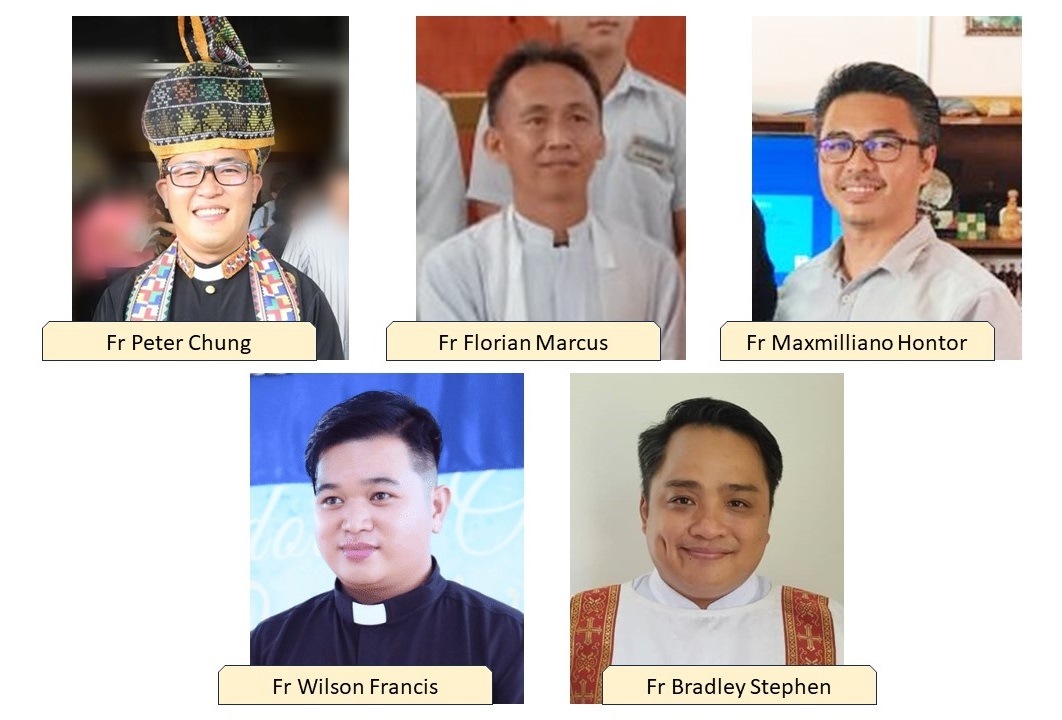
The Jesuits in Malaysia, some hailing from Sabah itself, are pioneers, companions, and mission-walkers who prefer dusty roads to red carpets. They live among the people, walk with the marginalised, and build God’s kingdom brick by brick, conversation by conversation.
.We can find them in schools that sharpen the mind,seminaries that shape the heart, and parishes that nurture the soul. They integrate faith with justice, culture and service, a combination that feels like Malaysia itself: diverse, dynamic, and deeply human.
My Personal Encounter with the Jesuits
At some point, the Jesuits stopped being “those priests in black” and quietly became part of my story.
It began at St Francis Xavier’s Church, Petaling Jaya where faith met friendship and kopi-O flowed as freely as grace. There I met Fr Peter Kim Se-Mang SJ, the indefatigable Sabahan Jesuit whose energy seemed powered by heaven itself.
Some people pass through your life like gentle breezes; others leave the kind of imprint that shapes your seasons. Fr Peter Kim SJ was one such person in my formative years as a youth and young adult – a priest, mentor, and fellow botany enthusiast who somehow managed to make both plants and parables come alive.
Perhaps, we first bonded over our mutual fascination with God’s green creation, he with his Jesuit curiosity for every creeping vine, and I with my budding love for botany. Beneath his humour and humility was a mind that saw no divide between faith and science – both were ways of knowing the Creator.
Ask for the grace to know and love God more intimately, so as to be able to serve Him more fully.”- St Ignatius of Loyola