

















By Joseph Masilamany
In the Borneo states of Sabah and Sarawak in Malaysia, the rumah panjai (a traditional indigenous longhouse) is more than a cultural artifact. It is a functioning social system, an architecture of life that binds leadership, responsibility, and community into a continuous lived reality.
As the Catholic Church in Malaysia continues its global journey toward synodality, this indigenous structure offers something increasingly rare in ecclesial discourse: a model in which participation is not periodic or procedural but embedded in daily existence.
At a time when synodality risks being reduced to meetings, documents, and consultation cycles, the longhouse presents a contrasting logic. It is not an idea of community. It is community: spatial, visible, and unavoidable.
Leadership rooted in proximity
At the center of the longhouse system is the tuai rumah (longhouse chieftain), whose authority rests less on formal hierarchy than on lived credibility. He arbitrates disputes, safeguards customary law (adat), coordinates decisions, and represents the community externally.
His defining feature is proximity. The tuai rumah lives among the people, often in a centrally located bilik (family unit), embedded within communal life. Authority is not buffered by distance; it is constantly tested in real time.
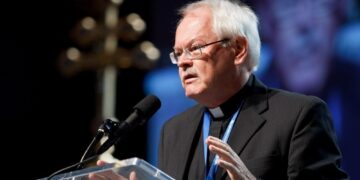
Charles Bertille, former executive secretary of the Catholic Bishops’ Conference of Malaysia, Singapore, and Brunei, who has conducted doctoral research among Catholic communities in Penang, Sabah, and Sarawak, observes that decision-making in such settings “evolves through wide consultation, informal dialogue, and gradual consensus-building. Leadership is not a static office, but a relational reality sustained by trust.”
He notes that longhouse life has sharpened his understanding of synodality. “The cultural image of the longhouse embodying synodal practices has shaped my research interest,” he says.
In contrast, Catholic structures often experience authority at a distance. Parishioners may know their priests, yet rarely feel structurally involved in decision-making.
“Participation is invited, but not structurally embedded,” Bertille notes. “That creates listening without shared responsibility.”
The longhouse offers a different premise: authority cannot function apart from proximity.
The architecture of shared life
The strength of the longhouse lies in its spatial logic. It is not just a dwelling but a map of relationships.
Each family occupies a bilik, a private space that affirms dignity and autonomy while not encouraging isolation. Every bilik opens into shared life through the tempuan, a narrow passage linking private and communal domains.
This threshold is more than architectural. It is social. It is where private life meets collective responsibility.
In ecclesial terms, this is where formation often weakens. Confined to classrooms or catechetical instruction, formation rarely inhabits the lived space where belief becomes participation. The tempuan suggests formation must be continuous, relational, and embedded.
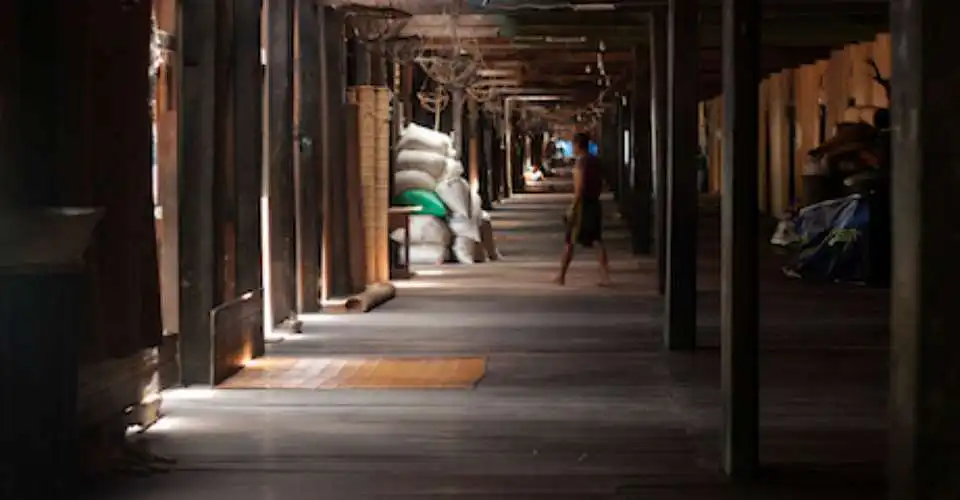
Beyond it lies the ruai (communal veranda), the spine of longhouse life. Here, the community becomes visible to itself through conversation, labor, ritual, and memory.
In the ruai, the longhouse’s communal corridor, randau unfolds: informal, unscripted conversations that often stretch late into the night. Here, disputes are aired, decisions take shape, and grievances are worked through in the open. It is also the setting for weddings, funerals, and communal celebrations. Notably, nothing is written down; there are no minutes, no paper trail only a shared memory that holds the community to its word.
There are no formal invitations. The space exists because life is shared.
This unsettles structured ecclesial models of synodality, which often depend on assemblies and formal consultations. The ruai suggests something more demanding: discernment as a continuous relationship rather than a periodic process.
“In the longhouse, dialogue is not organised, it is lived,” Bertille says. “Decisions emerge from everyday interaction. Yet there are also mandated structures for conflict resolution and communal governance. It is a centuries-old system.”
Synodality as lived responsibility
Responsibility in the longhouse is both visible and distributed.
Each family maintains the section of the ruai in front of its bilik, creating a shared system of stewardship. Neglect is immediately visible.
Accountability is social rather than bureaucratic. There are no audits, only presence. This produces a moral ecology where responsibility is constant, not episodic.
In many parish contexts, responsibility is concentrated in a small group, while broader participation remains limited. Synodality becomes structurally uneven. The longhouse exposes this imbalance: without shared responsibility, communal life weakens.
The outward edge: the tanju
Beyond the ruai lies the tanju, an open platform used for drying crops and ritual activity. It faces outward toward the environment.
Symbolically, it represents openness. The longhouse does not turn inward; it remains engaged with the world.
For the Church, this outward dimension is essential. Synodality cannot remain internal. It must extend into social engagement, justice, and public witness.
“A synodal Church cannot remain inward-looking,” Bertille says. “Listening must translate into action beyond the community. Practised with humility, the synodal style enables the Church to be a prophetic voice in today’s world … like a standard lifted among the nations (Is 11:12)”.
The tanju insists that communion must extend outward or risk becoming self-referential.
The limits of romanticisation
The longhouse should not be idealised. Its cohesion is sustained by necessity, proximity, and shared survival. Participation is not optional.
Modern Catholic communities operate in a different reality: urban, mobile, and individualised. The conditions that sustain the ruai cannot simply be replicated.
This raises a difficult question: can synodality thrive without a culture that demands participation?
Parallel experiments in community
Some evangelical communities in Asia have developed partial answers through small-group systems, decentralised leadership, and reproducible discipleship models. These function as contemporary echoes of the ruai, spaces of continuous dialogue and accountability.
Leadership is multiplied, not concentrated. Participation is expected, not optional.
The Catholic Church, by contrast, remains more centralised. It consults widely but governs from the center. Participation is invited, but not always embedded.
The tension is not administrative alone. It is cultural.
From consultation to culture
The longhouse suggests a shift: community is not sustained by declarations, but by design, by the architecture of relationships.
If taken seriously, the implications are significant. Authority must become more embedded. Lay participation must move from advisory to essential. Dialogue must become habitual rather than episodic. Governance must be lived daily.
Synodality, in this sense, becomes not an initiative but a way of inhabiting community.
“The challenge is not conceptual,” Bertille says. “It is cultural. Synodality requires a way of living, not just a way of meeting or administrative reform.”
Conclusion: A question of habitation
Sarawak’s longhouses have sustained this model for generations not through theory, but practice. Their strength lies in the integration of space, relationship, and responsibility.
For the Catholic Church, the challenge is not replication but recognition: that communion is sustained not only by structure, but by participation.
Bertille concludes with a sharper provocation: “The question is no longer whether the Church can organise synodality more effectively. It is whether we are willing to learn from our own peripheries where God speaks and where indigenous peoples have long lived forms of synodality.”
The final question is simple but demanding: will the Church learn not only to speak synodality but also to inhabit it? – UCA News
*The views expressed in this article are those of the author and do not necessarily reflect the official editorial position of UCA News.