




















By Kielce Gussie
The summer of 2026 has been marked by heatwave after heatwave. According to the US National Oceanic and Atmospheric Administration (NOAA), this July was the hottest on record globally since 1850 – tying only with July 2024 .
Across the world, people and societies suffered the consequences of this spike.
In Japan, temperatures soar as the country endures its longest 40°C (104°F) streak ever recorded. People are under extreme heat and hospitals and power systems face the threat of collapse as the temperature inches towards 49°C (120°F) in North Africa. Europe faced its second warmest July, which in turn had devastating effects. In France, over 7,300 people died as a result of the record number of high temperature days since the middle of June, according to an analysis by AFP.
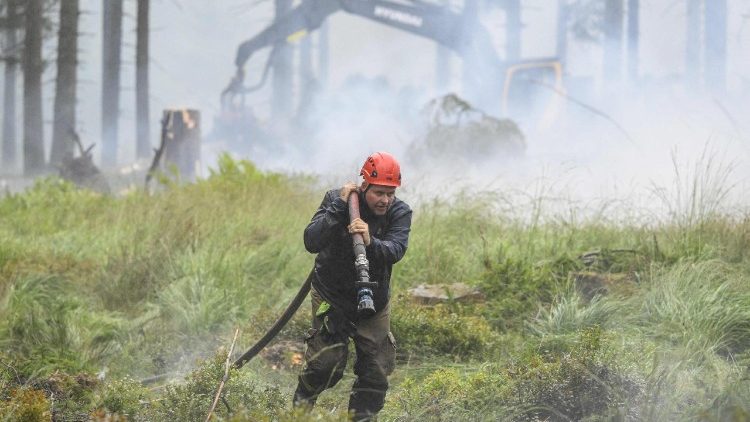
Western Europe recorded its hottest start to summer with repeated heatwaves in June and July, leading to droughts and wildfires. Belgium, Spain, France, Greece and Italy were among the nations that battled fires in these months.
By the end of the century, a study reports that wildfires are projected to burn 39% more of Europe, even if the best-case situation takes place to prevent the planet from heating. That figure can only change if serious action is taken to better manage the fires.
From small fires to blazing infernos
This 2026 fire season across Europe is becoming the third worst on record, following 2025 and 2022, as data published by the European Forest Fire Information Service explains.
The rise in hot, dry, and windy weather has led to small fires becoming blazing infernos as carbon pollution increases the temperature. Researchers report that the worst-case scenario sees the global heating hit 3.6C higher than pre-industrial levels. If that happens, the area that would burn would almost triple.
While bettering fire management can help limit the rise in temperatures by more than 70%, studies show improvements will not completely eliminate them.
Ecosystem researcher at the Potsdam Institute for Climate Impact Research (PIK) and lead author of a study, Maik Billing, explained that if “we go on a path of high emissions … we still see strong increases in burnt area. Fire management cannot replace climate mitigation.”
Leave coal, gas, oil behind
“The climate alarm is blazing from every direction”, UN Climate Change Executive Secretary, Simon Stiell, warned in a statement on Jul 28. He explained the world is facing climate-driven disasters, which have reached “nightmare proportions, as the costs of humanity’s addiction to burning coal, oil and gas keep spiraling upwards.”
The call to change was made years ago, but the shift to concrete action – from fossil fuels to clean energy and a focus on protecting forests and oceans – is not happening fast enough.
Fires, droughts, high temperatures, etc. are no longer theories but the “lived reality for billions in a world getting rapidly hotter,” the Executive Secretary continued, stressing a clear answer: “Leave coal, oil and gas behind faster, scale up renewables, and protect people where the impacts are already hitting hardest.”
Yet, hope remains. As Pope Francis urged in his 2015 encyclical, Laudato si’, there is still time to address and remedy the climate change situation. “Humanity still has the ability to work together in building our common home . . . Truly, much can be done! (paragraph 13)”
To mark the 10th anniversary of the publication of this document, Pope Leo XIV addressed participants in the “Raising Hope” Conference held in Castel Gandolfo in October 2025. He reiterated the words of his predecessor, calling on the global family to work together to “seek a sustainable and integral development”.
Now, more than ever, the issues outlined in Laudato si are relevant and are in need of immediate attention. – Vatican News