















By Joseph Tek Choon Yee
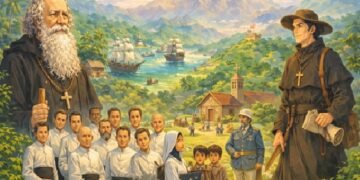
Faith had come to North Borneo quietly, sometimes by accident, sometimes by courage, and often by boat. From the early missionary traces to the restless vision of Don Carlos Cuarteron, the Gospel had brushed these shores more than once.
But touching the shore is one thing. Taking root is another.
What began with a Spanish sailor and a handful of missionaries would, in time, become a living local Church in Sabah. The decisive turn came in 1881, when the Mill Hill missionaries arrived from England.
From that moment, the Catholic story here began to change shape. Chapels appeared by riverbanks and village paths. Schools opened their doors to young minds. Mission stations slowly stitched together scattered communities across rivers, forests and hills.
Yet the real growth of the Church did not come from missionaries alone. It also came from the people of Sabah. Quietly. Steadily. Village by village. Family by family.
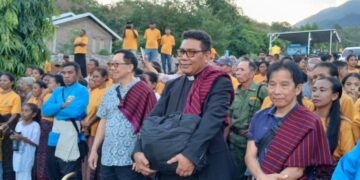
The bridge between missionaries and communities was built by local catechists. Long after missionary boats had disappeared over the horizon, these men and women carried the faith on foot from kampung to kampung. In many places, the first teacher of the Gospel was not a foreign priest but a familiar face from the village itself, someone who spoke the language, knew the customs, and understood the rhythms of daily life.
They gathered families for prayer, taught children the catechism, led devotions, explained Scripture, and kept faith alive between the rare visits of travelling priests.
Through them, the Church slowly ceased to feel foreign. It became Sabahan.
Catechists, villages and the Dusun embrace
Missionaries may plant the seeds, but ordinary people make faith truly belong to the land. That is one of the deepest lessons of Sabah’s Catholic story.
The Mill Hill missionaries, often affectionately described as “Jack of all Trades”, were ready to serve wherever work was needed. They built chapels, opened schools, tended missions, trained catechists, and did what needed doing with that old-fashioned missionary mixture of discipline, faith and stubborn endurance. In a sense, they were part priest, part builder, part teacher, part traveller, and occasionally, one suspects, part amateur geographer.
But the deeper transformation came when the Gospel moved beyond the missionaries and into the villages. Faith no longer travelled only by boat. It travelled by foot.
Catechists became the quiet backbone of the Church. A missionary responsible for a vast district might visit a village only once every few months. In between, catechists gathered families, taught children, explained the Gospel in familiar language, and guided communities in prayer.
History rarely prints their names in bold letters. Yet without them, the Church in Sabah would never have taken root as it did. They were not merely assistants. They were the daily grammar of the faith.
Penampang: A heartland emerges
One place where this transformation became especially visible was Penampang, home to many Kadazan-Dusun communities.
Here the missionaries found fertile ground for pastoral work. Local communities welcomed education and were open to the message of the Gospel. Mission schools drew young students. Catechists explained Christian teachings within familiar cultural worlds. Slowly, the Church became woven into village life – not as an imported structure dropped from above, but as something that began to breathe with the people.
Sunday Mass became part of the weekly rhythm. Church feasts blended naturally with local custom. Faith and culture learned, if not always effortlessly, then at least fruitfully, to walk together.
Over time, Penampang became widely recognised as one of the strongest Catholic heartlands in Sabah, a place where generations grew up with the Church not as something foreign, but as something deeply their own.
It is one thing for a mission to arrive. It is another for a people to say, quietly but firmly: this, too, is ours.
Tambunan and the interior
Beyond the coastal plains lay the mountainous interior.
Places such as Tambunan, Keningau and Tenom presented enormous challenges for missionaries. Roads were few. Travel was slow. Villages were scattered. Communication could take days, sometimes longer. The map may have looked neat on paper, but on the ground the mission was made of mud, sweat, rivers, leeches, long walks and no small amount of patience.
Yet the missionaries pressed on. Supported by catechists and local communities, mission stations gradually appeared deeper inland. Faith spread not through dramatic spectacles or grand public triumphs, but through patient accompaniment. Village by village. Family by family. Roof by roof. Prayer by prayer.
Missionary life in Borneo demanded sacrifice. Many Mill Hill priests endured illness, loneliness, exhaustion and isolation. Some died young. Others spent decades serving communities far from the lands of their birth.
Yet they stayed. They learned local languages. Walked muddy jungle paths. Celebrated Mass under simple wooden roofs. Baptised the young. Buried the dead. Taught the faithful. Encouraged the uncertain. And slowly, almost quietly, the Catholic Church in North Borneo grew stronger.
Not with a trumpet blast. More like a root system. Deepening unseen until one day the tree is unmistakably there.
War and the test of faith
History, however, has its seasons of trial. In 1942, the Japanese occupation brought one of the darkest chapters in the Church’s history. Missionaries were monitored, travel was restricted and communication with the outside world disappeared. Fear entered the ordinary fabric of life.
Some priests were advised to leave. Many chose to stay. Because shepherds do not abandon their flock.
During the occupation, families prayed quietly in their homes while catechists kept small communities together. Faith moved from public gatherings into private spaces, into whispered prayers, hidden courage and quiet endurance.
Several missionaries were imprisoned and killed. These men are remembered today as the Martyrs of North Borneo, witnesses whose courage lay not in grand speeches, but in the simple refusal to abandon their calling.
Martyrdom is often imagined in stained-glass colours. In reality, it is usually less theatrical and more costly. It is the long obedience of staying put when fear says flee.
Their witness might easily have faded into archives and footnotes. But through the work of Fr Cosmas Lee, especially in his book, Ultimate Sacrifice, The Tragic and Unaccounted Death of Catholic Missionaries in North Borneo Towards the End of WWII, their stories were gathered, preserved and retold for later generations.
Buildings were destroyed during the war, including the church that would later become Sacred Heart Cathedral in Kota Kinabalu.
Yet while structures fell, faith endured. Churches can be rebuilt. Faith must be carried.
When the war ended in 1945, the Church rebuilt alongside the wider community. By 1949, Sacred Heart Church had risen again, not merely as a structure of timber and brick, but as a symbol of resilience, memory and hope.
Tensions and turning points
Another major test came in the early 1970s, when immigration policies led to the departure of many foreign missionaries.
The sudden shortage of clergy created real pastoral strain across Sabah. Missions that had long depended on outside personnel were forced into a difficult reckoning.
Yet what looked like a setback became a turning point. Lay leaders stepped forward. Local priests emerged. Communities learned to rely more fully on their own strength.
From necessity came renewal. There is an old truth here: sometimes a Church only discovers its legs when it is forced to walk on its own.
Vocations increased. Parish life deepened. The Church in Sabah became more self-reliant, more confident, and more firmly rooted in its own people. What had once been mission territory was learning to become home ground.
“Catechists became the quiet backbone of the Church. A missionary responsible for a vast district might visit a village only once every few months. In between, catechists gathered families, taught children, explained the Gospel in familiar language, and guided communities in prayer. History rarely prints their names in bold letters. Yet without them, the Church in Sabah would never have taken root as it did. They were not merely assistants. They were the daily grammar of the faith.”
Continue reading part four