













First reading Jeremiah 3:14-17
Come back, my disloyal children
Come back, disloyal children – it is the Lord who speaks – for I alone am your Master. I will take one from a town, two from a clan, and bring you to Zion. I will give you shepherds after my own heart, and these shall feed you on knowledge and discretion. And when you have increased and become many in the land, then – it is the Lord who speaks – no one will ever say again: Where is the ark of the covenant of the Lord? There will be no thought of it, no memory of it, no regret for it, no making of another. When that time comes, Jerusalem shall be called: The Throne of the Lord; all the nations will gather there in the name of the Lord and will no longer follow the dictates of their own stubborn hearts.
Responsorial Psalm Jeremiah 31:10-13
The Lord will guard us as a shepherd guards his flock.
O nations, hear the word of the Lord,
proclaim it to the far-off coasts.
Say: ‘He who scattered Israel will gather him
and guard him as a shepherd guards his flock.’
For the Lord has ransomed Jacob,
has saved him from an overpowering hand.
They will come and shout for joy on Mount Zion,
they will stream to the blessings of the Lord.
Then the young girls will rejoice and dance,
the men, young and old, will be glad.
I will turn their mourning into joy,
I will console them, give gladness for grief.
Gospel Matthew 13:18-23
The man who hears the word and understands it yields a rich harvest
Jesus said to his disciples: ‘You are to hear the parable of the sower. When anyone hears the word of the kingdom without understanding, the evil one comes and carries off what was sown in his heart: this is the man who received the seed on the edge of the path. The one who received it on patches of rock is the man who hears the word and welcomes it at once with joy. But he has no root in him, he does not last; let some trial come, or some persecution on account of the word, and he falls away at once. The one who received the seed in thorns is the man who hears the word, but the worries of this world and the lure of riches choke the word and so he produces nothing. And the one who received the seed in rich soil is the man who hears the word and understands it; he is the one who yields a harvest and produces now a hundredfold, now sixty, now thirty.’
_____________________________________________
The conditions of our hearts
Today, let us take a moment to reflect on Jesus’ explanation of the parable of the sower and the seeds. In this parable, the seed represents God’s Word, while the different types of soil symbolise our hearts. The path stands for those who hear God’s Word but fail to let it take root. The rocky soil describes those who receive the Word with enthusiasm, yet lack the depth to withstand challenges, leading them to give up when troubles arise. The thorny ground illustrates a heart that allows the Word to grow but is ultimately choked by worries, wealth, and worldly pleasures. Finally, the good soil represents the heart that listens, truly understands, and bears fruit.
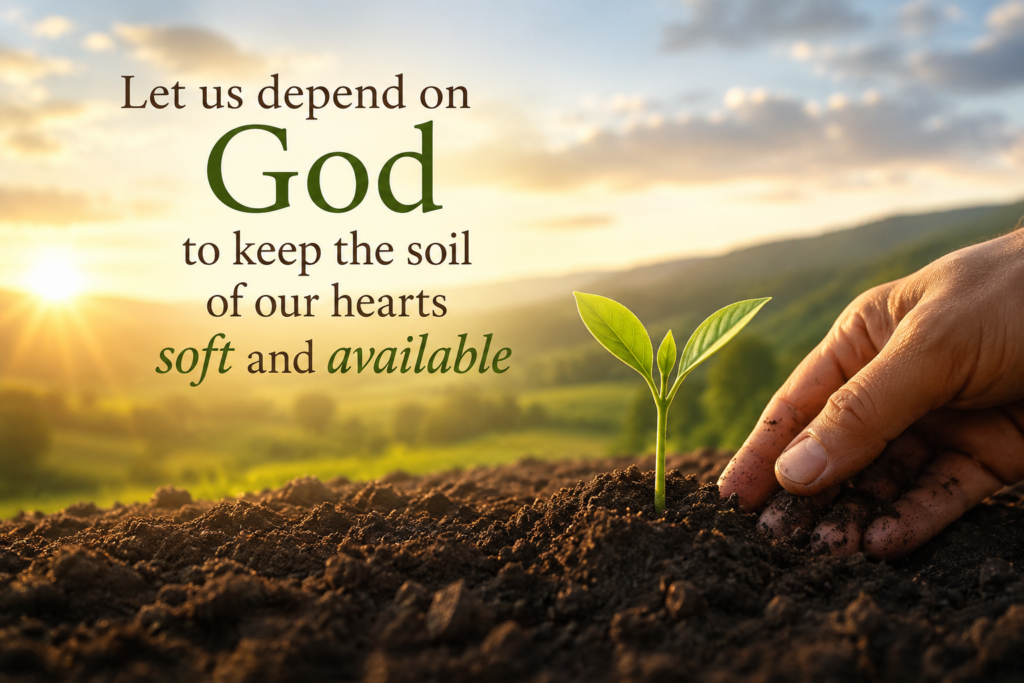
We are called to be “good soil,” but this does not mean we need to be perfect. Instead, it is about being open, receptive, and persevering. God scatters His Word daily in our hearts. Our part is to create space to listen to His Word, pay attention to its growth, and to remove “thorns” of unhealthy attachments and distractions that stop it from growing. Let us depend on God to keep the soil of our hearts soft and available.
Reflective question:
What must I change within myself for God’s Word to take deeper root in me?
Acknowledgment: Reflections are based on “Prayer for Living: The Word of God for Daily Prayer Year A” by Sr Maria Jose FMVD