











By Joseph Masilamany
“Let us go over to the other side.” Just eight words make up a compelling mission statement from three of the four Gospels. These words of Jesus lend direction to his disciples before they get into a boat and cross the Sea of Galilee.
But where is the “other side?” Gentile territory, the region of the Decapolis: mostly inhabited by Greek settlers and a local Semitic population with Hellenistic influence, offering Greek worship and temples dedicated to pagan deities.
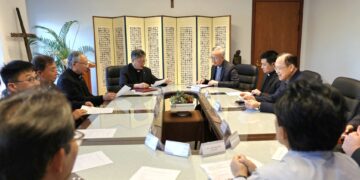
The words of Jesus could not be more germane to the Malaysian Church as it prepares to sit for the Malaysia Pastoral Convention 2026 in Sarawak from Sept 9-13 to address four main concerns: Family (Amoris Laetitia, Christus Vivit), Church (Evangelii Gaudium), Society (Fratelli Tutti), and Ecology (Laudato Si’) — closely echoing the synodal journey encouraged by Pope Francis.
Close to 1,000 delegates from Sabah, Sarawak and Peninsular Malaysia, consisting of nine dioceses, will congregate for the first national pastoral convention of its kind which hails the theme “Celebrate, Listen, Walk.”
While the theme is appropriate, an underlying question sparks a thought: “After celebrating and listening, will the Church “walk” across to the other side, as Jesus instructed his disciples?”
The familiar shore
The local Church is familiar with its own shore. Sunday Mass, parish meetings, catechism classes, pastoral ministries, and Friday night praise and worship. All these have a purpose. They are details in a typical parish community: to pray, serve and belong as much as to pray, pay and obey.
However, familiarity and routine participation in these activities can become a comfort zone. We know what we are doing. We are aware of the tasks. And everything is predictable.
But Jesus made a challenging move. He crossed over to the other side, reaching out to people beyond the social and religious boundaries of his time — he entered unfamiliar territory.
The true essence of the Church shines brightest not among those comfortable within parish life, but at the margins — in the peripheries of despair and desolation.
Crossing will not be easy
The journey of Jesus and his disciples across the lake was hit by a storm. Waves crashed against the boat, and fear gripped the disciples, yet Jesus calmly challenges their doubt, leaving them completely astonished.
Following faith is never easy. The Malaysian Church, too, will face its own tempest — political restrictions on Christian outreach, its minority status in a predominantly Muslim society, and the temptation to retreat into caution and self-censorship in public advocacy.
But these challenges cannot become an excuse for silence. The Church cannot pretend that faith is a private matter with nothing to do with the world around it. If the Gospel is truly Good News, then it must speak to the realities of people’s lives even when the waters are rough, the issues are sensitive, and the cost of crossing to the other side is real.
Living the Gospel means moving past words to real action by standing side-by-side with those who are oppressed.
Listening is only the beginning
Listening matters. But we cannot stop after listening.
If young Catholics say they feel unheard, the answer cannot simply be another youth forum. If migrant workers are being exploited, listening must lead to action. If indigenous communities are losing their ancestral lands, the listening Church must decide where it stands, not from a distance, but alongside them.
If families are trapped in poverty, the Church must do more than distribute food. It must ask the harder question: Why are they still hungry?
“Celebrate. Listen. Walk.” And of course, we must also “act.” That is how the MPC2026 motif must eventually mobilise itself with action.
Who gets to shape the Church?
There is another question worth asking in Sibu: What does it really mean to involve lay people? Lay Catholics already do much of the work: teaching, organizing, visiting the sick, running charitable programs, serving as Eucharistic ministers, handling communications and serving in parish ministries in a myriad of ways.
But helping the Church is not the same as helping to shape its direction.
A synodal Church must do more than ask lay people to fill gaps left by clergy. It must trust them. Lay people should not simply be invited to attend programmes. They should have a voice in shaping them. Women, indigenous Catholics, migrants and others whose experiences are often discussed should also have a place in the conversations where decisions are made.
The Church must go beyond just listening to them. Is the Church prepared to let “what they say” change it?
Why Sibu matters
The choice of Sibu is significant. Sabah and Sarawak have their own experience of Catholic life. In many Borneo communities, faith is closely tied to family, village, community and environment. The Church has also played a major role in education and social development, particularly in remote areas.
Peninsular Malaysia brings different experiences: urban parishes, established institutions, schools, and decades of living as a Christian minority in a Muslim-majority region.
There is much to learn from one another. Perhaps Sibu can become more than a place where delegates meet. It can become a place where the Malaysian Church recognizes that it needs all these experiences to face the future.
From the upper room to the other side
The most important part of MPC2026 will only begin when the delegates go home. Will there be fewer words and more action?
And perhaps this is where Jesus’ words become most challenging: “Let us go over to the other side,” because when Jesus reached the region of the Gerasenes, he did not find a welcoming party but a violent naked man living among the tombs. He was isolated, distressed and rejected by society. People had tried to restrain him with chains. In Mark’s Gospel, he calls himself “Legion.”
The image of the Gerasene demoniac remains powerful today as people live among their own modern tombs: on the streets, under bridges, in abandoned buildings, in institutions, and in lonely homes. Some live with mental distress, abandoned by their families. Many are homeless. Some are elderly and forgotten by children.
Crossing the water, Jesus found a man everyone else had given up on. Perhaps that is where MPC2026 must take us, not to another set of resolutions, but to the people we have trained ourselves not to see.
Every convention eventually ends. The delegates leave, the banners are removed, and the Catholic media will file a story. But before that, someone will ask: “Where do we go from here?”
Will Sibu be just another convention, or will it become a Pentecost moment? And yet Pentecost was not about staying in the upper room. It was about being “sent out.” That is what mission means — from the Latin missio, “to be sent.”
When Sibu ends, the mission begins. The Church must go out, cross its own troubled waters and reach the other side — its own Gentile territory, its own Decapolis. There, beyond the familiar shore, an “aha!” moment may open our eyes and a “Eureka!” moment may expand our horizons.
But the real epiphany comes in the encounter: with what, and with whom, we have not yet seen. For there, seeing becomes understanding, understanding becomes mission, and mission becomes the Church Christ calls it to be: a missionary Church — not one that simply keeps its routine beat. – UCA News
*The views expressed in this article are those of the author and do not necessarily reflect the official editorial position of UCA News.