








By Benedict Tang
Each November, Matthew Tserng Jia Uei writes his ancestors’ names on his parish’s list of the departed, and the priest then offers them bread and wine at Mass.
On the anniversary of his grandmother’s death, he requests a Mass to be said for her, a practice he began after becoming a Catholic at 19.
Tserng grew up in a Taoist household in Singapore that kept an ancestral tablet, which bears the names of a person’s deceased ancestors and serves as a focus for family remembrance and photographs in the kitchen.
The graves were in China, so they made offerings at home on death anniversaries, in the seventh lunar month and at Chinese New Year, the 61-year-old semi-retired shipping container assistant said.
In 1984, he became Catholic and stopped worshipping the gods and making offerings before ancestors. His father was baptized in 2000 and his grandmother in 2001.
After that, the family removed the altar and the tablets, kept only the photographs and stopped the ancestral offerings.
Today, Tserng leads and teaches the Mandarin-language Rite of Christian Initiation of Adults (RCIA) at the Church of the Blessed Sacrament.
“God is the one true God; there is no other,” he said. “Honoring our ancestors is remembering those who came before us.”
At non-Catholic funerals, he offers incense at the wake.
If he cannot avoid a religious rite, he participates but does not bow in worship before the altar.
“I only hold the incense and walk around in a circle and do nothing else,” he said.
Bowing, incense, ceremony not unusual
Each Chinese New Year, Michael Robert Tan visits the temple where his family keeps their ancestors’ tablets. He bows and holds incense with his relatives, as he did before his baptism in Apr 2024.
“It is more about remembering our ancestors than about worship,” said Tan, 57, an IT professional and a member of the Church of Divine Mercy. The family keeps no ancestral altar at home.
However, coming from a family that practiced a blend of Buddhism and Taoism, he continued to observe the death anniversaries and Chinese New Year visits even after baptism.
“Bowing, incense, and ceremony are not unusual,” he said.
The practice caused “no tension at all” in his family, he added.
All Souls’ Day on Nov 2 has no special meaning for him yet. “Not really,” he said.
Tan takes part because he sings in his parish choir and prays that “the departed may enter heaven.”
‘What they mean’
Father John Chen, a Singapore archdiocesan priest, said that bowing before tablets, holding joss sticks, and participating in remembrance ceremonies “may serve as cultural expressions of respect rather than acts of worship.”
“The crucial question is not simply what outward actions are performed, but what they mean and signify to those who perform them,” he said.
“Becoming Catholic does not mean abandoning one’s family heritage,” he said.
The question divided the Church for two centuries.
In 1742, Pope Benedict XIV barred Chinese Catholics from ancestral rites. In 1939, the Vatican’s Congregation for the Propagation of the Faith allowed Catholics to take part in ceremonies honoring Confucius and the dead as civil customs.
Today, priests and bishops “generally refrain from regulating how the faithful worship in their homes,” said Michel Chambon, who researched Asian Catholicism at the National University of Singapore’s Asia Research Institute until June.
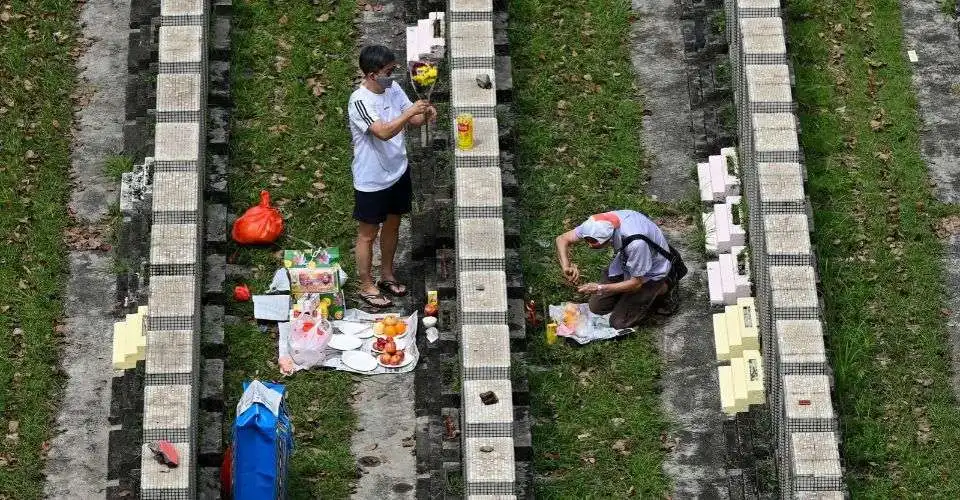
Such rituals take place mainly at home or at the cemetery, “two spaces over which the clergy exercises relatively little authority or control.”
The form and function of home altars also “are now evolving rapidly,” Chambon added.
In households headed by young or recently retired couples, “a dedicated altar is often absent,” he said.
In his 2025 study of Catholic homes in Taiwan, he found ancestral tablets “very rare,” though many Taiwanese parishes keep a communal altar for the tablets or portraits of deceased parishioners.
Father Luke Zhang from the Church of the Holy Trinity in Singapore draws the line at burning joss paper.
When a Catholic’s relatives honor the dead with folk customs, Catholics may bow “as a sign of respect for the dead,” offer flowers “as an expression of remembrance” and hold incense sticks “to represent our prayers for the dead,” he told UCA News.
“For us Catholics, the smoke from the incense is one of the means by which our prayers rise to our Triune God. However, we do not allow Catholics to burn joss paper or spirit money for the dead, as this is a superstitious practice that is inconsistent with the teachings of the Church,” he said.
Such practices “can help Chinese Catholics experience how faith and culture can come together without conflict” and promote family harmony, he said. Catholics in China, he added, are “more deeply influenced by traditional culture, and their ways of honoring their ancestors are more varied and elaborate. These practices always express respect, remembrance, and prayer for the dead, but do not involve any superstition.”
There is no conflict
Polly Ng Eng Lan, 65, a retired clerk and a parishioner of the Church of St Joseph (Bukit Timah) who accompanies catechumens in the Mandarin-language RCIA at the Church of St Alphonsus (Novena Church), also grew up Taoist and was baptized in 2004.
Her parents kept the ancestral tablets on the family altar with other deities and offered incense, flowers, and fruit on the first and 15th days of the lunar month and on death anniversaries.
After baptism, she offered incense only to her late father and took no part in other rites, such as burning joss paper.
Her parents were “very open and understanding,” she said, so there was no conflict.
Her late father’s memorial tablet was moved from the government-run Mount Vernon Crematorium and Columbarium to the Church of St Mary of the Angels, where she can visit at any time.
She now remembers him only there, lighting candles and praying for him, and has a Mass offered for him on his death anniversary and on All Souls’ Day.
The placement lasts 30 years. When it ends, the younger generation will decide whether to keep it, she said.
“I have told them to continue praying for the souls of the departed and offering Mass.”
It’s part of being a Chinese Catholic
Bryan Goh, a historian at the National University of Singapore specializing in the history of Catholicism in insular Southeast Asia, said Teochew Catholics in Singapore, whom he has studied, mostly distinguish between “culture” and “religion.”
The community arrived in Singapore already practicing Catholicism, having converted generations earlier through missionary work in Shantou (Swatow) and Guangdong in China.
In 2018, a Teochew Catholic told Goh of an All Souls’ Day visit to his grandmother’s columbarium niche. About 20 relatives brought food and prayed a decade of the Rosary.
The children then tossed two coins, a Chinese divination practice called jiaobei. Two heads meant the grandmother had accepted the offerings.
“It’s not that we don’t believe in the Catholic faith; it’s part of being a Chinese Catholic!” the man’s uncle told him.
“The puritanism of wanting converts to only be Catholic and give up all other identities , rarely exists in Singapore or Southeast Asia at large,” Goh said.
However, among younger Chinese Catholics in Singapore today, Chambon said, “many are unfamiliar with these customs,” and many “simply remain unconcerned with these matters.” – UCA News