
















By Terry Priel
Asia was home to a near-record-high 16.9 million forcibly displaced people when the world marked Refugee Week last month.
That was only slightly down from the peak of 17.3 million at the end of 2024, according to a UN High Commissioner for Refugees (UNHCR) report released to coincide with the week (Jun 15 to Jun 21).
One in every 70 people, or 1.4 percent of the world’s entire population, is now forcibly displaced: refugees, Internally Displaced People (IDPs) and asylum seekers, making the current era one of the worst humanitarian crises since World War II.
And another 4.2 million will be forced from their homes by war, political upheaval, natural disasters, and the impact of climate change by the end of next year, the Danish Refugee Council (DRC) warned in a report in April.
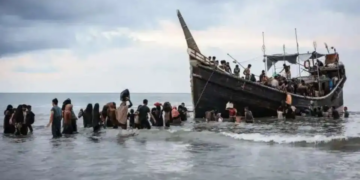
Myanmar, where a military regime seized power in a coup five years ago and is waging a brutal civil war and an ethnic cleansing pogrom against Rohingya Muslims and other minorities, will see the largest increase after Sudan with more than half a million more forced from their homes by the end of next year.
“The international community is facing a catastrophic failure to protect the world’s most vulnerable,” said council Secretary General Charlotte Slente.
“In 2025, there was a 14 percent surge in violence against civilians. From Sudan to Myanmar, warring parties routinely kill and injure civilians.
“Bombs are dropped on hospitals, schools and the markets that people depend on.”
A year of global ‘action and dialogue’
Refugee Week highlights the plight of displaced people through community-organized arts and cultural events and fundraising drives and personal stories of displaced individuals and families.
In some countries, like Cambodia, where some events included cyber scam victims helped by local parishes, the week ran for two weeks to Jun 26.
This year marks the 75th anniversary of the signing of the 1951 U.N. Refugee Convention on Jul 28, which will kick off a year of global “action and dialogue.”
The surge in the number of forcibly displaced people, many of them entire families comes as global aid and development funding is slashed, led by what Caritas calls the “killing” of the US Agency for International Development (USAID), which had accounted for 40 percent of global aid funding.
That has badly hit major Catholic NGOs helping refugees and IDPs around the world, such as the US-based Catholic Relief Services (CRS) which was the agency’s top NGO partner and Caritas, the Church’s social services arm.
The Trump administration’s aid cuts also wiped out 20 percent of the UNHCR’s budget and a quarter of its staff, forcing the closure of 80 field offices around the world.
At a time when millions more are being forcibly displaced, Caritas warns funding cuts and growing isolationism, apathy and donor fatigue will kill millions.
“Stopping USAID abruptly will kill millions of people and condemn hundreds of millions more to lives of dehumanizing poverty,” Caritas Internationalis Secretary General Alistair Dutton said when the cuts were announced.
“This is an inhumane affront to people’s God-given human dignity that will cause immense suffering. Killing USAID also presents massive challenges for all of us in the global humanitarian community, who will have to completely reassess whom we can continue to serve and how.”
Slashing support for all those groups playing a major role in helping displaced people around the world and the US is not alone in this undermines the entire international aid network.
The UNHCR, particularly so because in the 44 UN members that have not signed the convention and some, like China, that have, the UN refugee agency fills in for the government in providing core refugee management services.
The 1951 Convention and the subsequent 1967 Protocol to the Refugee Convention set out a range of legal safeguards, including the right to freedom of movement within the host country; the right to work, education, and housing; access to courts; and protection from being returned to their home country if there is a serious threat to their life or freedom.
Asia struggling with large numbers of refugees
Of the 44 UN states that have not signed, 14 are in Southeast Asia and South Asia. Only four in the region have signed: Afghanistan, Cambodia, the Philippines and Timor-Leste.
Asian countries that refuse to sign, many struggling with large populations of refugees from neighboring countries, say the convention is too Eurocentric and not suited to the geopolitical and socio-economic realities they face.
They have a point: work on the treaty signed in 1951 actually began three decades earlier, in 1921 when the League of Nations, the precursor to the UN, began drafting a document to deal with mass displacement after World War I.
They say its legal requirements undermine their sovereignty and they fear they will be stuck with refugees permanently. Already, tens of thousands have lived for years in their host country.
Church leaders often remind us that Jesus was a refugee.
And Pope Leo XIV, in a Refugee Week message on Jun 21, said:
“I hope that the spirit that inspired the drafting of this important international instrument may also continue to enlighten the consciences of national leaders today.
“No one can turn a blind eye to those who are seeking protection and safety,” he said, adding people everywhere should “welcome those who are victims of persecution so that they may live in peace, with dignity, and look to the future with hope.”
As many around the world celebrate the life-saving achievements of the Refugee Convention and other international safeguards, there is still much more to be done.
The moral and practical challenge we face is doing ever more with ever less in a world of increasing need and desperation. – UCA News
*The views expressed in this article are those of the author and do not necessarily reflect the official editorial position of UCA News.