















By Joseph Tek Choon Yee
Read part one
He knew Rajah James Brooke, the famed White Rajah of Sarawak. He interacted with British administrators such as Spencer St John, and at times clashed with officials like Hugh Low. He worked among local rulers and communities whose own political realities shaped life in the region. It was not an easy balance. Cuarteron often found himself navigating not only oceans, but politics.
In the book, Crowned with the Stars by Mike Gibby, Cuarteron was described as something of a “storm petrel” – a seabird known for flying boldly through turbulent weather. The metaphor fits perfectly. His life seemed permanently surrounded by storms: storms of politics, storms of missionary struggle, and occasionally very real storms at sea.
As I read about Cuarteron’s extraordinary life, my mind wandered back to a cinema. Like many of my generation, I once watched the film The Mission, the powerful story of Jesuit missionaries working among indigenous communities in South America. The film left a deep impression on me – not only because of its haunting music, but because it captured something rarely understood outside missionary circles: the quiet courage of those who carry faith into uncertain lands.
In the film, missionaries walk into jungles, defend vulnerable communities and navigate the uneasy alliances of empire, commerce and faith. Reading about Cuarteron years later, the resemblance struck me. Different continent. Different century. But the same spirit.
Men who could have lived comfortably elsewhere choosing instead to walk into distant frontiers – not driven by adventure, but by conviction. Missionaries rarely appear heroic in their own time. Often, they simply appear stubborn. History later calls them pioneers.
The First Apostolic Prefect
In 1857, Cuarteron was appointed the first Apostolic Prefect of Labuan and Borneo, establishing the earliest Catholic missionary jurisdiction in the region. For readers unfamiliar with Church structures, an apostolic prefect is essentially a missionary leader appointed by the Vatican to guide the Church in a region where the Christian community is still young.
Think of it as the startup phase of the Church. Instead of a bishop overseeing a mature diocese, a priest is entrusted with building the foundations – organising missions, nurturing communities and helping the Church grow strong enough one day to become a diocese.
In other words, Cuarteron was asked to build something from almost nothing. And the territory he was responsible for was enormous. Imagine trying to run a mission across an island the size of Borneo without roads, reliable communication or modern transport. Travel meant sailing between coastal settlements, navigating rivers deep into the interior, and sometimes walking muddy jungle paths for days.
There was no GPS. No WhatsApp. Just boats, boots and determination. Cuarteron dreamed not merely of building churches, but of building communities – places where people could live free from slavery, where education could flourish and where faith could grow alongside everyday life.
It was an ambitious vision. Perhaps even a slightly reckless one. But pioneers rarely succeed by thinking small. The realities of North Borneo, however, proved tougher than even Cuarteron’s determination. Resources were scarce. Support from Europe was uncertain. Political tensions complicated missionary work. And the vast geography of the island made pastoral care extraordinarily difficult.
Even a man as driven as Cuarteron could not build the mission alone. Eventually the early mission weakened, and the Catholic presence in North Borneo struggled to survive. But history would later reveal something important. Seeds planted with conviction rarely disappear. Sometimes they simply wait quietly beneath the soil.
The Mill Hill Missionaries
History often moves in chapters. If Don Carlos Cuarteron was the restless sailor who first carried the Catholic flame into North Borneo, the Mill Hill Missionaries were the men who arrived to keep that flame burning. And they came from a place very different from Borneo – England.
The story begins in Mill Hill, a quiet suburb in North London. In 1866, a visionary English priest, Cardinal Herbert Vaughan, founded a missionary society dedicated to bringing the Catholic faith to distant lands. It soon became known simply as the Mill Hill Missionaries.
Their training ground was peaceful, rolling English countryside, brick buildings, study and prayer. But the world awaiting them was anything but peaceful. Young missionaries knew they would travel far, but few truly understood where they would end up.
Some would be sent to one of the most challenging mission fields in Southeast Asia: North Borneo. By the late nineteenth century, the mission begun by Cuarteron had weakened. The land was vast, communities scattered and church structures fragile. The Vatican needed a society capable of rebuilding the mission. The task fell to the Mill Hill missionaries.
In 1881, the first priests arrived, led by Fr Thomas Jackson, who became the Prefect Apostolic. They arrived quietly, with few possessions but strong resolve to begin again. North Borneo was unlike anything they had known. England’s cool rain was replaced by thick tropical humidity. Mountains, dense forests and winding rivers separated villages across great distances.
The missionaries soon realised that in Borneo, rivers were the real roads. Boats carried them along the Papar, Tempasuk and Marudu rivers, often accompanied by villagers and catechists. Travel was slow, sometimes exhausting. But slowly, relationships formed. Trust grew. And with trust came faith.
The early churches were simple wooden chapels built with local materials and local hands. Yet these humble structures became centres of community life, places for prayer, learning and gathering.
The missionaries also understood something vital: the Church grows not through buildings alone, but through relationships and education. Mission schools provided many communities with their first access to formal learning.
But perhaps their greatest legacy was the catechists, local men and women trained to teach the faith and guide their villages. Missionaries might visit occasionally. Catechists remained. And through them, the Gospel traveled steadily from village to village across North Borneo.
From Mission to Home: How Faith Became Sabahan
After the pioneering efforts of the Mill Hill missionaries, the story of the Catholic Church in Sabah did not grow through priests alone. It grew through people in Sabah. Quietly, steadily, village by village.
The real bridge between the missionaries and the communities was the catechists who carried the faith on foot long after the missionary boats had sailed away. In many kampungs, the first teacher of the Gospel was not a foreign priest but a familiar face from the village. They gathered families for prayer, taught children the catechism and kept the faith alive between the rare visits of travelling priests. Through them, the Church slowly became not something foreign, but something Sabahan.
Then came the storms of history. During the Japanese occupation in World War II, several missionaries chose to remain with their people despite grave danger. Some paid the ultimate price and are remembered today as the martyrs of North Borneo, quiet witnesses that faith is not merely preached but lived, even in the darkest hours.
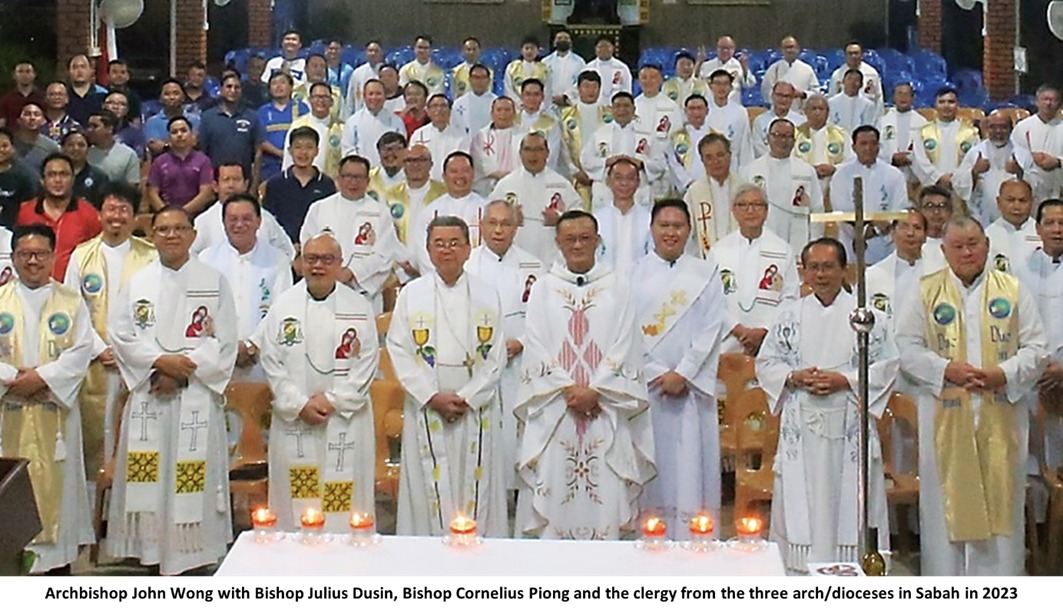
The post-war years brought rebuilding, new vocations and growing local leadership. Yet another testing moment came in the early 1970s, when immigration policies led to the departure of many foreign missionaries. What seemed like a setback became a turning point. Lay leaders stepped forward. Local priests emerged. The Church learned to stand on its own feet. In time, mission territories matured into dioceses, with Sabahan bishops shepherding their own communities. This is another story in the pipeline.
What began with a Spanish sailor and a handful of missionaries had become a living local Church. The faith that once arrived quietly by boat now sails outward again – carried by Sabahan hearts into the wider world.
The horizon is wide, the winds uncertain. The question now is how we will steer the journey ahead.