

























By Marilyn Gerard
KUALA LUMPUR – As digital technologies become increasingly woven into everyday life, the need to cultivate healthier and more intentional online habits has never been greater. Recognising this challenge, the Women Ministry of the Archdiocese of Kuala Lumpur (AOHD), in collaboration with SIGNIS Malaysia, recently organised a seminar titled Addressing Invisible Cuts: Safeguarding Our Digital Wellbeing.
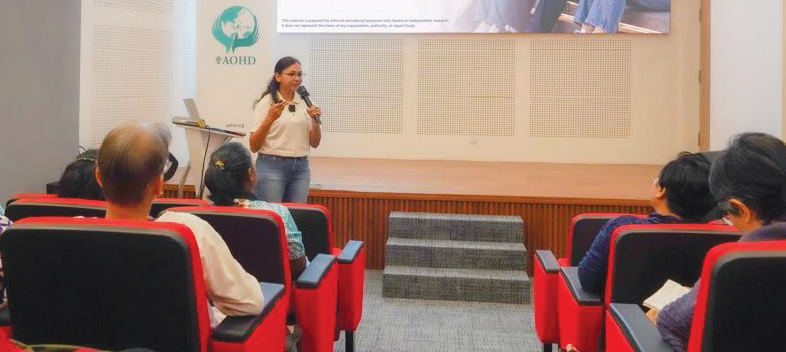
Held at the Cahayasuara auditorium, the seminar brought together participants to reflect on the often-overlooked impact of digital technologies on mental, emotional and social wellbeing. Through engaging presentations and discussions, attendees were encouraged to become more mindful and responsible digital citizens in an era of constant connectivity.
Karen Arukesamy, media and communications specialist and president of SIGNIS Malaysia, highlighted how technology has transformed the way people interact with media and one another.
“What we repeatedly see online has the power to shape how we think and behave. Many digital harms do not begin with major incidents but with small habits that become routine and go unnoticed. Every click, share, comment and reaction contributes to the digital environment we all live in,” she said.
Karen noted that convenience, while beneficial, can gradually influence behaviour without people realising it. Actions that begin as conscious choices often become automatic habits over time. She also pointed out that technology increasingly performs tasks once carried out mentally, potentially diminishing attentiveness and critical thinking.
“Responsible digital citizenship begins with a simple principle — pause before you click, verify before you trust, and think before you share. Digital wellbeing is ultimately a human issue. It affects our attention, relationships, communities and future,” she said.
She cautioned that familiarity with technology can create a false sense of security and reduce scrutiny. “Awareness alone does not make us safe. Consciousness requires effort. We must actively make wise choices online.”
Karen encouraged participants to adopt practical digital safety measures, including verifying links and sources, using strong passwords and two-factor authentication, reviewing privacy settings regularly, reporting scams, balancing screen time, and helping family members and friends navigate the digital world safely.
The seminar also featured a session by Raymund Jagan, a registered counsellor and member of SIGNIS Malaysia, who explored the psychological impact of social media and digital platforms.
“We used to be consumers of media. Today, we have all become content creators and distributors,” he said.
Raymund explained that social media platforms often stimulate the release of dopamine, a neurotransmitter associated with anticipation and reward. The uncertainty of receiving likes, comments and shares can lead users to repeatedly check their devices, reinforcing potentially addictive behaviours.
He also discussed the role of oxytocin, a hormone linked to trust and social bonding, noting that while it strengthens relationships, it can also make individuals more susceptible to accepting online information without sufficient critical evaluation.
“People naturally seek connection and belonging. Unfortunately, this can sometimes lead them to trust information online too easily,” he said.
Encouraging participants to be more present in their daily lives, Raymund challenged them to “live in the moment, not record the moment,” urging them to focus on meaningful experiences rather than constantly documenting them for social media.
He also proposed community-based play sessions for children as a practical way to reduce screen dependency and reconnect young people with outdoor play and nature. Church compounds, with their safe and open spaces, could serve as ideal venues for such initiatives.
Raymund further introduced the concept of “friction-maxxing”, which involves intentionally embracing small inconveniences rather than seeking constant ease and instant gratification. By developing greater tolerance for discomfort, individuals can strengthen self-discipline, improve focus and cultivate a healthier relationship with technology.
The seminar concluded with a call for greater personal responsibility in shaping healthy digital habits. As technology continues to influence every aspect of modern life, participants were reminded that safeguarding digital wellbeing requires not only awareness, but also conscious action, discipline and a shared commitment to building safer and healthier online communities. – Herald Malaysia